The Renovation Slowdown Is Coming. Not Everyone Will Feel It.
Harvard forecasts remodeling growth falling to 0.5% by early 2027, below inflation. Contractors with recurring revenue barely feel it. Build yours now.
On this page
For four years, remodeling work has been a rising tide. Home values climbed, people stayed put and poured money into the houses they already owned, and almost any contractor with a truck and a phone number stayed busy. That tide is going out.
The good news is it's going out slowly, not crashing. The better news, if you've set your business up right, is that you might not feel it at all.
Harvard's Joint Center for Housing Studies just told us roughly when and how hard. The contractors who read that forecast and act on it now will be fine. The ones who wait until the phone gets quiet will be reacting from behind.
What Harvard Is Actually Forecasting
The Joint Center for Housing Studies runs something called the LIRA, the Leading Indicator of Remodeling Activity. It's the closest thing the industry has to a national weather report for home improvement spending.
Here's what it says. Annual homeowner spending on improvements is expected to reach about $518 to $526 billion by the end of 2026 (Harvard JCHS). That's a big number, and it's still growing. The problem is the speed.
Growth is decelerating from roughly a 2% annual rate in early 2026 down to about 0.5% by the first quarter of 2027 (Harvard JCHS). Cut the growth rate by three quarters in twelve months and you've got a market that's still moving forward, just barely.
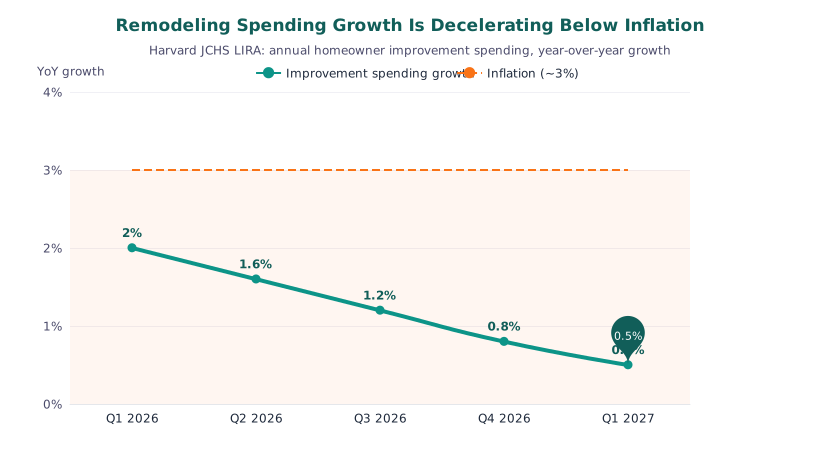
Look at the gap on that chart. The teal line is spending growth sliding from 2% toward 0.5%. The dashed orange line is inflation, sitting around 3%. The whole forecast period, that teal line lives below the orange one. The space between them is the part nobody puts on a flyer.
Why 0.5% Is Worse Than It Sounds
A half a percent of growth sounds like a flat year. It isn't. It's a shrinking one.
When spending grows 0.5% but prices across the economy are climbing 3% or more, the money is worth less than the year before. That 0.5% nominal growth is below inflation, which means real spending is actually declining (Harvard JCHS). Homeowners are putting fewer real dollars into their houses even though the headline number ticks up.
For a contractor, that shows up as quoted jobs that don't close, projects that get trimmed from a full kitchen to just the countertops, and customers who say "let's wait until spring." None of it feels like a recession. It feels like a market that got a little stickier and a little cheaper at the exact moment your material and labor costs kept climbing.
One thing worth keeping in perspective: the remodeling market is still about 50% above where it sat before the pandemic (Harvard JCHS). The boom isn't reversing back to 2019. There's plenty of work out there. It's just no longer growing fast enough to cover for a business that runs lean on planning.
Who Feels It First
The slowdown won't hit every contractor on the same day, or with the same force. It depends almost entirely on where your revenue comes from.
If your business runs on one-off big projects, you're the most exposed. The whole-house remodel, the $40,000 roof replacement, the addition, the gut renovation. That work is discretionary, financed, and easy for a homeowner to postpone when they're nervous about their job or their savings. When growth flattens, the first thing buyers cut is the large optional project. Your pipeline is only as full as your next round of leads, and those leads just got more expensive and slower to close.
A contractor doing four $30,000 jobs a month has a beautiful month and a terrifying one, depending on how many of those land. Take away even one a month in a softening market and revenue drops 25% while the trucks, the insurance, and the crew all cost exactly what they did before. The numbers that predict your next bad month start flashing long before the bank account does, but only if you're watching them.
Who Barely Notices
Now picture the contractor across town with 700 maintenance agreements on the books.
When the big-project market cools, that contractor's revenue floor doesn't move. The agreements bill on schedule no matter what the housing market does. The tune-ups still get scheduled. The service calls still come in, because a water heater doesn't care what the LIRA says. Recurring revenue smooths out seasonality and demand dips, which is the whole reason it's worth building.
This is the same dynamic I broke down in the maintenance contract math, and it applies far beyond HVAC. A plumber with a backflow testing program, an electrician with annual safety inspections, a roofing company with a gutter-cleaning and inspection plan. Different trades, same hedge. You've converted a chunk of your revenue from "hope the phone rings" to "scheduled and predictable."
The contractor with the maintenance book also gets a second advantage during a slowdown. They're already in the home. When a maintenance customer's 14-year-old system finally dies, that contractor sells the replacement off a relationship instead of a cold lead. In a market where new leads are drying up, the work you've already earned access to is worth more than ever.
The Demand That Isn't Going Anywhere
The slowdown is a story about discretionary spending. It is not a story about repairs, and that distinction is your opening.
People don't choose when their pipes burst or their furnace quits. They live with a worn-out kitchen for another year, sure, but they fix the thing that's actively flooding the basement today. Repair and replacement demand is far stickier than renovation demand, and two forces are propping it up right now.
First, the houses themselves. New homebuyers spend up to $10,000 on unexpected repairs within their first two years of ownership (Jobber, June 2026). Every closing in your service area is a customer who is about to discover what the inspector missed. That's recurring, non-discretionary work landing in your market every month, recession or not.
Second, the lock-in effect. High mortgage rates have homeowners staying put rather than selling, because trading a 3% mortgage for a 7% one to buy the same house makes no sense. So they renovate and maintain the house they're stuck in instead of moving. That keeps a baseline of improvement and upkeep demand flowing even as the big optional projects soften. The homeowner who can't move still needs the deck repaired and the AC serviced.
Neither of these is a reason to relax. They're a reason to point your business at the work that holds up when the discretionary stuff fades.
The Move: Build the Book Before You Need It
The mistake is waiting. Maintenance programs take months to build into a meaningful share of revenue, and the worst time to start is after the slowdown has already thinned your project pipeline and your cash. You build the hedge while you're still busy, so it's there when you're not.
A few things that work, regardless of trade:
Offer the agreement on every completed job. Your tech is already in the home and the customer already trusts them. That's the cheapest contract you'll ever sell. A contractor who pitches a service plan on 100% of jobs and closes even a quarter of them builds a recurring book faster than any marketing campaign could.
Price it to stand on its own. The agreement should be profitable on the maintenance work itself, with the replacement and repair upsells treated as the upside. Most residential plans land somewhere in the $150 to $300 a year range, billed monthly so it's easy on the customer and steady for you.
Make it auto-renew. A plan that requires a phone call to renew leaks customers every cycle. A plan that renews on a card on file holds them. Retention is the entire point, so remove every reason for the customer to actively decide to leave.
Watch the recurring percentage like a number that matters to your survival. Track what share of your revenue is contracted versus one-off, and watch it weekly. If it's drifting down, you find out in days instead of at tax time. This is also one of the first things a buyer looks at, because recurring revenue is a huge piece of what your business is actually worth.
What This Looks Like in a Weekly Report
When we read a contractor's QuickBooks data, splitting recurring revenue from one-off project revenue is one of the first cuts we make. Most owners genuinely don't know their own ratio. They feel busy and assume the mix is fine. The data says otherwise more often than not.
An automated insight from a weekly report reads something like this:
Revenue Concentration Risk: Recurring revenue is 6% of total this period. One-off project work makes up 81%, with the top three jobs accounting for 54% of revenue. With national remodeling growth forecast to fall to 0.5% by early 2027 (below inflation), a single quarter of softer project demand would put pressure on fixed costs. Building recurring agreements toward a 20% to 25% floor would cover roughly two-thirds of monthly overhead before a single project closes.
That's specific, it's tied to your actual numbers, and it connects a national trend to a decision you can make this month. Not a generic warning to "diversify."
We also track the trend over time, so you can see your recurring share climbing week over week as the program grows. The slowdown Harvard is forecasting is a slow-motion event. You get plenty of warning. The only question is whether you're looking at the right number while there's still time to do something about it.
The tide's going out either way. Build the part of your business that floats.
Streett Reports reads your QuickBooks data and emails you a plain-English insight report every week, including your recurring revenue percentage and how local demand trends are shifting under you.
Your first report is free, no credit card required.
See what this looks like for YOUR business
Connect your QuickBooks in about 2 minutes. Your first report is free.
Get Your Free Report →