The Maintenance Contract Math: How HVAC Service Agreements Change Everything
HVAC companies with 25-35% recurring revenue from maintenance contracts have higher margins, smoother cash flow, and businesses worth 2x more. The math behind why.
On this page
Your best month last year was $240K. Your worst was $78K. Same team, same trucks, same overhead.
That swing is the HVAC business model working exactly as designed: you're weather-dependent, season-driven, and one mild October away from a payroll scramble. Most HVAC owners accept this as the cost of being in the trade.
It doesn't have to be.
The companies that don't panic in shoulder season all have the same thing in common. They built a maintenance contract base large enough to cover fixed costs even when the emergency calls stop. And the financial difference between having that base and not having it is much larger than most owners realize.
The Shoulder Season Problem
HVAC is the most volatile residential trade in terms of seasonal revenue. The numbers look like this:
- Peak months (July, August, January, February) generate 3-4x the revenue of shoulder months.
- Shoulder months (March, April, September, October) see a 25-40% revenue drop from peak.
- A $1.8M HVAC company can swing from $240K in July to $78K in April. Same payroll both months.
Cash flow management tops the worry list for roughly 40% of HVAC owners (RelayFi, 2026). And it's not because they're bad at money. It's because the business model is structurally volatile. You're selling an emergency service driven by temperature. When the weather is mild, the phone goes quiet.
Plumbers don't have this problem at the same scale. Their peak-to-trough swing is 15-25%. Electricians? 10-15%. HVAC? You're riding a 25-40% roller coaster, every single year.
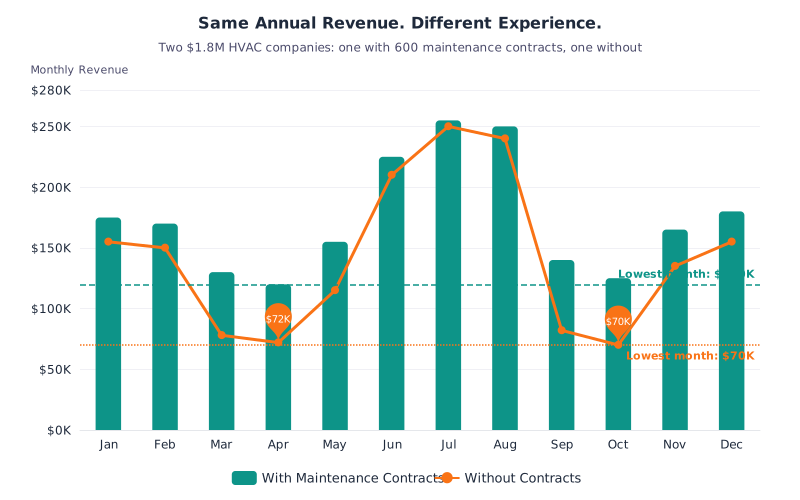
Look at that chart. Same $1.8M in annual revenue, two different companies. The teal bars are the company with 600 maintenance contracts. The orange line is the company without any. In peak months (July, August) they look almost identical. But look at April and October. The orange line drops to $70K-$72K. The teal bars never go below $120K. That $50K difference in your worst month is the difference between scrambling for payroll and running a calm, planned business.
What Maintenance Revenue Actually Does to Your Numbers
Forget the sales pitch about "customer loyalty" for a second. Look at what contracts do to the core financial metrics that determine whether your business is healthy or fragile.
Margin Improvement
Maintenance work carries 55-65% gross margins. Transactional repair work? 35-45%.
The reason is straightforward. Maintenance visits are scheduled, not dispatched. Your tech drives a planned route, not a panicked scramble across town. There's no diagnostic uncertainty. No "while I'm here" scope creep. No emergency after-hours premium labor cost eating your margin on a $200 call.
On a $1.8M company running 30% maintenance revenue ($540K), that margin improvement adds roughly $80K-$100K to gross profit annually. Same revenue, more money kept.
Cash Flow Smoothing
Maintenance contracts bill monthly or annually, regardless of weather. That $45K/month hits whether it's 72 degrees or 105 degrees outside.
For a company with $180K in monthly fixed costs (rent, insurance, truck payments, base payroll), $45K in guaranteed maintenance revenue means you're 25% covered before a single service call comes in. That changes September from "are we going to make payroll" to "slower month, but we're fine."
The companies that build to 25-35% recurring revenue effectively eliminate the shoulder season cash crisis. They still have peaks and valleys in total revenue, but the floor never drops below their break-even point.
Retention That Compounds
The average HVAC contractor loses 11% of customers every year. Most leave because they feel forgotten, not because they found a better price. They needed service, Googled "AC repair near me," and called whoever came up first. Your name wasn't on their radar because you hadn't talked to them in two years.
Customers on maintenance plans? 80%+ annual retention. Some companies report 96%. The contract creates a reason to be in the home twice a year. That presence alone is worth more than any marketing campaign you could run.
Companies without agreements retain somewhere between 20 and 30 percent of customers year over year (SmartAC, 2026). That's not a retention problem you can solve with better follow-up emails. It's a structural gap that only a recurring service relationship closes.
And retention compounds. If you retain 85% of maintenance customers vs. 25% of one-time customers, the gap widens every year. After five years, you've kept 44% of the original maintenance cohort but only 0.1% of one-time customers. Those retained customers refer, they approve bigger jobs, they don't price-shop.
The Replacement Conversion Engine
This is where maintenance contracts earn back multiples of their face value.
Customers on maintenance plans convert to system replacement jobs at 3-5x the rate of cold leads. When your tech is in the home twice a year running a tune-up, they build trust. When they say "this compressor is working hard, you've got maybe two seasons left," the customer believes them.
That replacement job, worth $7,000-$18,000 depending on the system and market, was sold during a $150 maintenance visit. Not a $2,000 marketing campaign. Not a cold Google Ads lead that your CSR had to fight for.
Industry benchmarks estimate the average HVAC customer lifetime value at roughly $15,340 per residential client (Coach Ellie Marshall, 2026). That number includes repeat service, maintenance, and replacement work over time. Maintenance contract customers hit the high end of that range because they stay long enough to buy a replacement system.
The Benchmarks: Where Do You Stand?
| Maintenance Revenue % | What It Means |
|---|---|
| 0-10% | Reactive only. Feast-or-famine cash flow. |
| 10-20% | Some stability. Still weather-dependent. |
| 25-35% | Industry leader. Predictable base, smoothed seasonality. |
| 35%+ | Exceptional. Near-immunity to seasonal swings. |
If you're below 10%, you're running a purely reactive business. Every dollar has to be earned fresh from inbound calls driven by weather, marketing spend, and luck.
If you're at 25-35%, your fixed costs are largely covered by predictable revenue. The phone can go quiet for two weeks and nobody panics.
The US HVAC services market is $54.7 billion in 2026, growing at 5.8% annually (MarkWide Research). Maintenance and repair services captured 46% of total HVAC industry revenue in 2025 (Mordor Intelligence). The market is moving toward recurring service, not away from it. Companies that build their contract base now are positioning themselves in the direction the industry is already heading.
The Business Value Multiplier
We covered business valuation in depth before, but the maintenance contract number is worth revisiting in context.
HVAC companies with strong maintenance programs (25%+ recurring revenue) sell for 5-8x EBITDA. Companies without them sell for 2-4x.
On a $500K EBITDA company, that's the difference between $1.5M and $3.25M. Same revenue. Same profit. Same trade. Different multiple because one company has predictable, transferable revenue that survives an ownership transition, and the other doesn't.
You don't have to be thinking about selling for this to be relevant. The same factors that make a business attractive to a buyer (predictable cash flow, high retention, strong margins, low owner-dependence) also make it easier and less stressful to run day-to-day. A business worth more is a business that runs better.
What This Looks Like in a Weekly Report
When we analyze an HVAC company's QuickBooks data, maintenance contract revenue is one of the first things we measure. The automated insight looks something like this:
Recurring Revenue Below Target: Your maintenance contract revenue is 8% of total revenue this period. Industry leaders in HVAC run at 25-35%. Each maintenance agreement adds $150-300/year in guaranteed revenue and converts to replacement work at 3-5x the rate of cold leads. At your current average ticket of $185/agreement, reaching 20% recurring would require approximately 200 additional contracts.
That's specific, grounded in your actual numbers, and connects the metric to a business outcome. Not a generic "you should sell more maintenance plans" suggestion.
We also track how maintenance revenue interacts with seasonal patterns. When shoulder season hits and transactional revenue drops, we can quantify the gap:
Seasonal Vulnerability Detected: September revenue dropped 38% vs. August. Your maintenance revenue ($12K) covered only 7% of fixed costs. HVAC companies with 25%+ recurring revenue see shoulder months as planned slow periods, not emergencies. Current trajectory would require collections improvement OR accelerated contract sales to avoid the October cash flow gap we project based on last year's pattern.
The Math for a $1.8M HVAC Company
Let's make this concrete. Two companies, same annual revenue.
| Company A (No Contracts) | Company B (30% Recurring) | |
|---|---|---|
| Annual Revenue | $1.8M | $1.8M |
| Maintenance Revenue | $0 | $540K (600 contracts) |
| Gross Margin (blended) | 45% | 52% |
| Gross Profit | $810K | $936K |
| Worst Month Revenue | $78K | $120K |
| Months Below Break-Even | 3-4 | 0 |
| Customer Retention | ~25% | ~85% |
| Marketing Cost/New Customer | $300+ | $40 (referral from existing) |
| EBITDA Multiple (if sold) | 2-4x | 5-8x |
Company B makes $126K more in gross profit annually, never dips below break-even, spends a fraction on customer acquisition, and is worth double on paper. The only difference is 600 contracts at $900/year average.
Each of those 600 contracts isn't just $900 in annual revenue. It's a relationship that generates repairs, referrals, and eventually a $12,000 replacement system. The downstream value dwarfs the contract price.
Building the Base: What Actually Works
Starting from zero (or near-zero) contracts and getting to 25% recurring revenue is a multi-year effort. But the financial impact starts showing up immediately, even at 50-100 contracts.
Offer it on every service call. Your tech is already in the home. The system just broke or needed repair. The customer is already thinking about their HVAC. This is the highest-conversion moment you'll ever get. If your techs aren't offering a maintenance plan on 100% of completed service calls, you're leaving contracts on the table.
Price for value, not cost. Most residential maintenance agreements land at $150-300/year (or $15-25/month). The customer gets two tune-ups, priority scheduling, and a discount on repairs. You get guaranteed revenue, a twice-yearly opportunity to sell, and 85%+ retention. Price it so you're profitable on the maintenance work itself, and treat the downstream revenue as pure upside.
Automate the renewal. Contracts that require a phone call to renew have worse retention than contracts that auto-renew on a credit card. Every friction point you remove from renewal increases retention by measurable percentage points. The companies reporting 96% retention have auto-renewal as the default.
Track it weekly, not annually. If you only look at your contract count once a year, you won't notice when attrition creeps up or when new signups plateau. Weekly visibility means you catch problems in weeks, not quarters. That's exactly the kind of metric a weekly financial report surfaces automatically.
One More Thing Energy Prices Do For You
Residential electricity prices have been rising 6-8% year-over-year in many states (EIA data). Natural gas isn't far behind. That trend makes efficiency upgrade conversations much easier during maintenance visits.
Your tech is in the home doing a tune-up on a 15-year-old system. The customer mentions their electric bill was $280 last month. Your tech can now have a real conversation about a high-efficiency replacement that would cut that bill by 30-40%. That conversation wouldn't have happened without the maintenance visit. The customer wouldn't have called you about their energy bill.
Rising energy costs make maintenance contracts more valuable to the customer (a well-tuned system runs cheaper) AND more valuable to you (the upgrade conversation happens naturally, in-home, with trust already established).
Streett Reports tracks maintenance revenue percentage, seasonal cash flow patterns, and margin breakdowns automatically from your QuickBooks data. Every week. No spreadsheets, no manual categorization.
Your first report is free, no credit card required.
Or see what it looks like first: Sample HVAC Report →
Related: What Your Business Is Actually Worth → | HVAC vs Plumbing vs Electrical: Financial Patterns → | How to Know If You're Charging Enough →
See what this looks like for YOUR business
Connect your QuickBooks in about 2 minutes. Your first report is free.
Get Your Free Report →