What Your Business Is Actually Worth (And the One Metric That Doubles It)
Plumbing businesses sell for 2.9-5x EBITDA. HVAC companies with maintenance contracts sell for 5-8x. Here's what drives the difference and how to position your business at the top of the range.
On this page
Every Contractor Thinks About It
You've thought about it. Maybe not today, maybe not this year. But at some point, every contractor who's built something real asks the question: what would someone actually pay for this?
Maybe you're five years from retirement and starting to plan. Maybe you're ten years out but curious. Maybe a competitor got acquired last year and you heard a number that made you sit up straight. Or maybe you just want to know that the thing you've been grinding on for a decade is worth more than the trucks in the parking lot.
Here's the problem: most contractors have no idea what their business is actually worth. They guess. They ask a buddy who sold. They Google "how much is my business worth" and get generic advice about 2-3x revenue that doesn't apply to their trade, their size, or their situation.
The real answer depends on your trade, your financials, and one specific metric that can literally double your valuation. We're going to cover all three.
The Basic Math: How Business Valuation Works
Before we get into trade-specific numbers, you need to understand the two metrics buyers use to value a home services business.
SDE (Seller's Discretionary Earnings)
SDE is the total financial benefit the owner gets from the business. It's your net profit plus your salary, plus any personal expenses you run through the company (your truck payment, your phone, your health insurance, that "business trip" to Cabo).
SDE is the standard for businesses under $1 million in earnings where the owner is actively working in the business. That's most contractors.
SDE = Net Profit + Owner's Salary + Owner's Benefits + One-Time/Non-Recurring Expenses
EBITDA (Earnings Before Interest, Taxes, Depreciation, and Amortization)
EBITDA strips out financing decisions, tax strategies, and accounting methods to show the raw operating profitability of the business. It's the standard for larger businesses or businesses where the owner could be replaced by a manager.
EBITDA = Net Income + Interest + Taxes + Depreciation + Amortization
For most contractors in the $500K-$5M revenue range, buyers will look at both. SDE matters more for smaller owner-operated shops. EBITDA matters more as you scale and the owner becomes less essential to daily operations.
What "Multiples" Mean
When someone says a business sold for "4x EBITDA," they mean the buyer paid four times the annual EBITDA as the purchase price.
$500K EBITDA x 4 = $2,000,000 purchase price.
Simple math. The hard part is knowing what multiple applies to your business. That's where trade and business quality come in.
Valuation Multiples by Trade
Not all home services businesses are valued equally. The market has clear preferences, and they're driven by predictability, growth potential, and risk.
| Trade | Typical Multiple (EBITDA) | Median Asking Price | Key Value Driver |
|---|---|---|---|
| HVAC (with maintenance contracts) | 5-8x | Varies widely | Recurring revenue, replacement cycle |
| HVAC (without maintenance contracts) | 2-4x | Varies widely | Seasonal, project-dependent |
| Plumbing | 2.9-5x | ~$795K | Essential service, aging infrastructure |
| Electrical | 3-5x | Varies | Steady demand, code-driven work |
| Roofing | 2-4x | Varies | Weather-dependent, project-based |
| General Contracting | 2-3.5x | Varies | High competition, low barriers |
A few things jump out from this table.
First, the ranges are wide. A plumbing business can sell for 2.9x or 5x. On $287K in SDE (the median for plumbing businesses on the market), that's the difference between $832K and $1.4M. Same trade, same general size. Over half a million dollars in difference based on business quality.
Second, HVAC has the widest range of any trade, and it splits cleanly on one factor. We'll get to that in a moment.
Third, the market is hot. Plumbing business median sale prices increased 46% from 2022 to 2025 according to BizBuySell data. HVAC median sale prices increased 23% from 2021 to 2025. The US HVAC services market is projected to grow from $18.98 billion in 2026 to $25.35 billion by 2031. Buyers are paying premium prices because the fundamentals are strong.
The One Metric That Doubles Your Valuation
Look at that HVAC row again.
With maintenance contracts: 5-8x EBITDA. Without maintenance contracts: 2-4x EBITDA.
That's not a small difference. That's a 2x difference at the midpoint. On a $500K EBITDA business, that's the gap between selling for $1.5 million and selling for $3.25 million.
The one metric is recurring revenue percentage. Specifically, the percentage of your total revenue that comes from maintenance contracts, service agreements, and other predictable, repeating income.
HVAC companies with 25-35% of revenue from maintenance contracts consistently sell at the top of the range. Companies with zero recurring revenue sell at the bottom. The correlation is that direct, and buyers will tell you it's the single most important factor in their valuation model.
Why Buyers Pay Double for Recurring Revenue
Put yourself in a buyer's shoes for a moment. You're about to write a check for $2 million to buy a contracting business. You have two options:
Company A: $500K EBITDA. All revenue comes from one-time service calls and project work. If the phone stops ringing next month, revenue goes to zero. Every dollar has to be re-earned from scratch.
Company B: $500K EBITDA. $150K of that comes from 600 maintenance contracts that renew automatically every year. Those customers are locked in. They're paying whether or not they need a repair this month.
Company B has a floor. Even if marketing stops working, even if the economy dips, even if the previous owner's reputation fades, there's $150K in revenue that shows up regardless. That's not just revenue. That's certainty. And certainty is what buyers pay premium multiples for.
The Math That Makes Buyers Pay Premium
Let's make this concrete with a worked example.
Scenario: Two HVAC companies, both with $500K EBITDA
| Company A (No Contracts) | Company B (30% Recurring) | |
|---|---|---|
| Annual Revenue | $1.8M | $1.8M |
| EBITDA | $500K | $500K |
| Recurring Revenue | $0 | $540K (600 contracts) |
| Recurring Revenue % | 0% | 30% |
| Likely Multiple | 2-4x | 5-8x |
| Valuation Range | $1.0M - $2.0M | $2.5M - $4.0M |
| Midpoint Valuation | $1.5M | $3.25M |
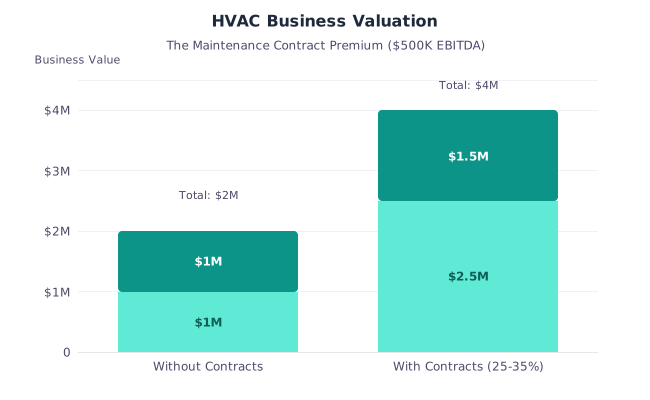
The difference: $1.75 million. Same revenue. Same profit. Same trade. Same market. The only difference is how predictable that revenue is.
That $1.75 million gap is the value of 600 maintenance contracts at $900/year average. Each contract is worth roughly $2,900 in business valuation on top of the revenue it generates. That's the math that should change how you think about every maintenance agreement you sell.
The Compounding Effect of Maintenance Contracts
Recurring revenue doesn't just boost your multiple. It improves the underlying EBITDA that the multiple gets applied to. Here's why:
Higher margins. Maintenance contracts carry 55-65% gross margins compared to 35-45% on transactional repair work. The work is scheduled, predictable, and efficient. No emergency dispatch, no diagnostic uncertainty, no "while I'm here" scope creep eating your estimate. (For a full comparison of how margins, seasonality, and business value differ across trades, see our trade comparison.)
Better conversion rates. Customers on maintenance plans convert to replacement jobs at 3-5x the rate of cold leads. When your tech is in the home twice a year doing a tune-up, they build trust. When they say "this system has maybe two years left," the customer believes them. That replacement job was sold during a $150 maintenance visit, not a $2,000 marketing campaign.
Retention. Customers on maintenance plans have 80%+ retention rates. They don't price-shop. They don't call your competitor when something breaks. They call you, because they're already your customer. That retention compounds year over year into a customer base that grows without proportional marketing spend.
Seasonal smoothing. Maintenance revenue comes in year-round. It fills the valleys between peak seasons. For HVAC, that means cash flow in March and October when neither heating nor cooling is driving emergency calls. For plumbing, it means steady income during the summer months when burst pipes aren't happening. Buyers love businesses without seasonal cash flow crises.
Each maintenance contract is worth $150-300/year in guaranteed revenue. But the downstream value (replacements, referrals, retention, margin improvement) makes each contract worth far more than its face value to a buyer evaluating your business.
What Else Drives You to the High End
Recurring revenue is the biggest single factor, but it's not the only one. Here's what moves you from the low end to the high end of your trade's multiple range.
Diversified Customer Base
The rule: no single customer should represent more than 15% of your revenue.
Buyers calculate customer concentration risk before anything else. If one general contractor sends you 30% of your work and that relationship ends, the business loses a third of its revenue overnight. That's not a business. That's a dependency.
Residential service companies naturally have better diversification than commercial-focused shops. If your biggest customer is 3% of revenue, that's a strength worth highlighting.
Clean, Accurate Books
This one is more important than most contractors realize. Buyers discount for uncertainty. If your QuickBooks is a mess, if expenses are dumped into "miscellaneous," if your P&L doesn't match your tax returns, if you can't produce clean financials for the past three years, buyers assume the worst.
Clean books don't just help at sale time. They help you run the business better every single week. Properly categorized expenses, reconciled accounts, clear separation between owner draws and business expenses. The businesses that sell for top multiples are the ones where a buyer can look at the financials and immediately understand the business.
Consistent Revenue Growth
Three or more years of consistent growth signals a healthy business with market demand. Buyers want to see a trend, not a spike. A company that grew 8-12% per year for four years is more attractive than one that doubled last year (because that spike might not repeat).
Growth doesn't have to be dramatic. Steady, predictable growth at or above inflation tells a buyer the business has momentum and the market supports continued expansion.
Low Owner-Dependence
If you do all the selling, all the estimating, all the customer relationships, and all the key decisions, a buyer is buying a job, not a business. When you leave, the value walks out the door with you.
Businesses that sell for premium multiples have systems. A sales process that doesn't depend on the owner's personal relationships. Technicians who can run jobs without the owner on-site. An office manager who handles scheduling and dispatch. Standard operating procedures that a new owner can follow.
The test: could you take a month off and the business would run at 80%+ capacity? If yes, you have a sellable business. If no, you have a sellable job.
Strong Online Reputation
In home services, reviews are the new word-of-mouth. A business with 200+ Google reviews at 4.7 stars has a marketing asset that a buyer inherits. A business with 12 reviews at 4.1 stars has a reputation problem that a buyer has to fix.
Your review profile is part of your valuation because it directly impacts future revenue. Strong reviews mean lower customer acquisition costs, higher booking rates, and better pricing power. All of which support the EBITDA that the multiple gets applied to.
What Kills Your Valuation
Just as certain factors push you to the top of the range, others drag you to the bottom. These are the red flags that make buyers either walk away or demand a steep discount.
Customer Concentration
If one customer represents more than 25% of your revenue, that's a major red flag. Buyers see it as a single point of failure. Lose that customer and the business economics collapse. Even 15-25% concentration from a single source will suppress your multiple.
The fix takes time. You can't diversify overnight. But you can start tracking it now and deliberately growing other revenue sources to dilute the concentration over 2-3 years before a sale.
Declining Margins
A business with shrinking margins tells a buyer that costs are outpacing pricing power. Maybe materials are rising and you're not passing it through. Maybe labor costs are climbing. Maybe you're taking on lower-quality work to fill the schedule. Whatever the cause, declining margins signal a business that's getting less profitable over time, and buyers will project that trend forward.
Owner Does All the Selling
If every estimate, every customer relationship, and every close depends on the owner, the buyer is taking enormous risk. What happens when the owner leaves after the transition period? The sales pipeline dries up.
This is fixable, but it takes 12-24 months to build a sales process that doesn't depend on one person. Start before you need to.
Messy Books
Buyers discount for uncertainty. If they can't clearly see revenue trends, margin trends, expense categories, and cash flow patterns in your financials, they assume the worst. "Messy books" doesn't just mean errors. It means inconsistent categorization, personal expenses mixed with business expenses, missing months, or financials that don't reconcile.
The discount for messy books is real and significant. Buyers will either walk away or apply a 20-30% haircut to account for the unknowns. Three years of clean, consistent, properly categorized financials is worth tens of thousands of dollars at sale time.
No Recurring Revenue
We've covered this, but it bears repeating in the context of what kills value. A business with zero recurring revenue is a business that starts from zero every month. Every dollar has to be re-earned. Every month is a new gamble on whether the phone rings.
Buyers see this as feast-or-famine cash flow risk. They price it accordingly with bottom-of-range multiples.
Seasonal Volatility Without Reserves
Every trade has seasonality. That's expected. What kills valuation is seasonal volatility without the financial reserves to weather it. If your business does $200K in July and $40K in January, and you have $8K in the bank in December, a buyer sees a business that's one bad month away from crisis.
Demonstrating that you manage seasonality (through reserves, maintenance contracts, or diversified service offerings) tells a buyer the business is stable even during slow periods.
How Weekly Financial Visibility Builds Value
Here's the thing about business valuation: it's not a number you check once when you're ready to sell. It's a number you build over years through consistent financial management.
Every factor that drives premium multiples is measurable. And every factor that kills valuation is detectable early, if you're watching.
Recurring revenue percentage is a number you can track weekly. Are maintenance contracts growing as a share of total revenue? Are you adding 2 contracts a week or 10? Is retention holding at 80%+ or slipping?
Customer concentration shifts gradually. A new commercial client that starts at 5% of revenue can creep to 20% over two years without you noticing, unless you're watching the distribution every week.
Margin trends don't collapse overnight. They erode slowly, a point here, a point there, until you look up and realize you're 6 points below where you were 18 months ago. Weekly visibility catches the first point of compression, not the sixth.
Revenue growth is a trailing metric. You can't fix last year's growth number. But you can see this quarter's trajectory in real time and make adjustments while there's still time to hit your annual target.
Clean books aren't a one-time cleanup project. They're a weekly discipline. Catching a miscategorized expense this week is trivial. Fixing 200 miscategorized expenses at year-end is a nightmare that costs you real money in accountant fees and buyer confidence.
The contractors who sell for top-of-range multiples aren't the ones who scramble to clean up their financials in the 6 months before listing. They're the ones who maintained clean, visible, well-tracked financials for years. When a buyer looks at their books, they see consistency, clarity, and confidence. That's what premium multiples are made of.
Whether you're selling next year or in ten years, the metrics that drive valuation are the same metrics that drive a well-run business today. Tracking them isn't just exit planning. It's better operations, better decisions, and more money in your pocket every single year between now and whenever you decide to sell.
Streett Reports tracks the metrics that drive business value: margin trends, customer concentration, recurring revenue percentage, and growth trajectory. Every week, in plain English. Whether you're selling next year or in ten years, knowing these numbers puts you in control.
Your first report is free, no credit card required.
Or see what value-building metrics look like: HVAC | Plumbing
See what this looks like for YOUR business
Connect your QuickBooks in about 2 minutes. Your first report is free.
Get Your Free Report →