Customer Concentration Risk: When One Client Is Too Much of Your Revenue
If one customer accounts for 25% of your revenue, you don't have a great client. You have a dependency. Here's how to measure concentration risk and what to do about it.
On this page
You have a great customer. They send you consistent work. They pay (mostly) on time. You've built a relationship with their property manager. When they call, you answer. When they need something squeezed in, you make it happen.
They're also your biggest business risk.
Not because they're a bad customer. Because they're too much of your revenue. And you probably don't know exactly how much.
What Customer Concentration Actually Means
Customer concentration is simple: what percentage of your total revenue comes from any single customer, or from your top handful of customers?
Here are the thresholds that matter:
- Any single customer above 15-20% of revenue = yellow flag. Worth monitoring. Not yet dangerous, but trending in a direction you need to watch.
- Any single customer above 25-30% of revenue = red flag. This is a dependency, not a customer relationship. If they leave, you're in serious trouble.
- Top 5 customers combined above 50% of revenue = concentration problem. Half your business depends on five phone numbers continuing to ring.
These aren't arbitrary numbers. They come from M&A due diligence standards, where buyers evaluate businesses for acquisition. In that world, any single customer above 15-20% of revenue, or the top 5 above 50%, deserves extra attention. Buyers know what most contractors don't: concentrated revenue is fragile revenue.
How It Builds Without You Noticing
Nobody wakes up one morning and decides to put 30% of their revenue in one basket. It happens gradually, and it feels like success the entire time.
Here's how it typically plays out for a plumbing company:
January: Riverside Property Management sends you a few service calls for their apartment complex. They're about 12% of your monthly revenue. A solid customer, nothing unusual.
February: Riverside acquires a second property. They like your work, so they route those calls to you too. You're happy. Revenue from them ticks up to 16%.
March: They pick up a third building. More work flows in. You're at 20% now, but you're not tracking percentages. You just know you're busy.
April: Riverside asks if you can handle their preventive maintenance program across all three properties. Of course you can. You hire a part-time tech to cover the volume. Revenue from Riverside hits 24%.
May: They close on a fourth property. You're their go-to plumber now. They mention it at a property management meetup. You feel great about the relationship. You're at 28%.
Six months. From 12% to 28%. At no point did anything feel wrong. Every step was a win. More work, more revenue, a growing relationship with a customer who pays and communicates well.
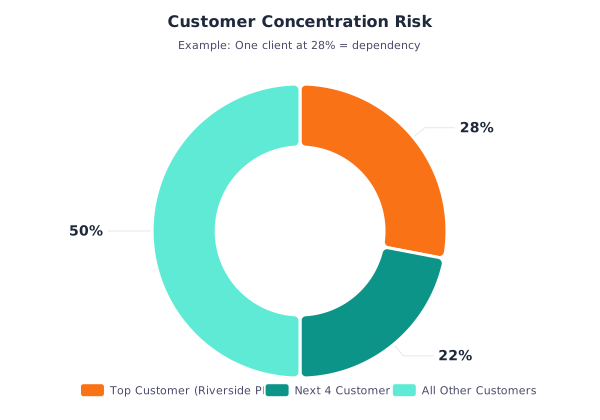
But now, if Riverside's new VP of operations decides to consolidate vendors, or if they get acquired by a national firm with existing contractor relationships, or if they simply decide to bid the work out for a lower price, you lose more than a quarter of your income overnight.
And you probably never saw the number 28% written down anywhere.
The Three Risks Nobody Talks About
Most people think customer concentration risk means "what if they leave?" That's real, but it's actually the least likely scenario in the short term. The more immediate risks are subtler and more corrosive.
1. Negotiating Leverage
When a customer knows they represent a large chunk of your revenue, the power dynamic shifts. They may not say it explicitly, but it shows up in conversations like:
"We're looking at our vendor costs across all properties. Can you sharpen your pricing a bit?"
You know what that means. And you know you can't afford to lose them. So you cut your rate by 10%. Then next year, they ask again. Your margins on their work compress steadily, but you keep saying yes because the volume matters.
A customer who's 8% of your revenue? You can hold your pricing. A customer who's 28%? You negotiate from weakness every single time.
2. Payment Leverage
The same dynamic applies to collections. When your biggest customer pays at 45 days instead of 30, what do you do? Send a stern collections email to the account that represents a quarter of your income?
Most contractors don't. They absorb it. They float the cash. They pay their suppliers on time while waiting for the big check to land. And the customer learns, consciously or not, that they can pay you whenever they feel like it.
Your average days-to-payment creeps up. Your cash flow gets lumpy. You start timing material purchases around when you expect their check. That's not a business relationship. That's a dependency.
3. Priority Displacement
This one is the most invisible. When Riverside calls with an emergency at 2 PM on a Tuesday, what happens to the residential customer you had scheduled at 3 PM?
They get bumped. Or they get the B-team. Or they get a callback that says "we can reschedule for Thursday."
Over time, your service quality for smaller customers degrades. They notice. They stop calling. They leave a mediocre review. And your customer base quietly narrows further, making you even more dependent on the big account.
It's a cycle: concentration leads to priority displacement, which leads to customer attrition, which leads to more concentration.
The Valuation Impact
If you ever plan to sell your business, or even if you just want the option, customer concentration directly impacts what a buyer will pay.
Here's the math that matters:
Plumbing businesses typically sell for 2.9 to 5x EBITDA (earnings before interest, taxes, depreciation, and amortization). That's a wide range. The difference between the low end and the high end often comes down to risk factors, and customer concentration is one of the biggest. (For the full picture of what drives contractor business valuations and the one metric that can double your multiple, see our valuation guide.)
Buyers discount 20-30% for high customer concentration. If your business generates $200K in EBITDA and would normally sell at 4x ($800K), but your top customer is 30% of revenue, a buyer might apply a 25% discount. That's $600K instead of $800K. You just lost $200,000 in business value because of one customer relationship.
Why do buyers care so much? Because they're buying future cash flows. If those cash flows depend heavily on one or two relationships that the current owner built personally, the buyer has no guarantee those relationships survive the transition. The customer might leave. The pricing might not hold. The priority treatment might not continue under new ownership.
From a buyer's perspective, concentrated revenue is unreliable revenue. And unreliable revenue gets discounted heavily.
Even if you never sell, this framing is useful. Your business is worth less when it depends on a small number of customers. That's true whether someone else is valuing it or you are.
How to Measure It
The good news: measuring customer concentration is straightforward. You don't need fancy software or an MBA. You need one sorted list.
Step 1: Pull your revenue by customer for the last 12 months. In QuickBooks, this is a Sales by Customer Summary report.
Step 2: Sort it from highest to lowest.
Step 3: Calculate each customer's percentage of total revenue. (Customer revenue / total revenue) x 100.
Step 4: Look at your top customer. Is it above 15%? Above 25%?
Step 5: Add up your top 5. Is the combined total above 50%?
That's it. Five minutes of work that most contractors have never done.
The harder part isn't the math. It's doing it consistently. Concentration changes over time, and a quarterly snapshot misses the slow creep from 12% to 28%. You need to track it regularly, ideally weekly or monthly, to catch the trend before it becomes a problem. (Building a Monday morning financial check habit is the simplest way to make this consistent.)
How to Fix It
If you discover you have a concentration problem, don't panic. You don't need to fire your biggest customer. You need to grow around them.
Diversify Your Revenue Sources
The goal isn't to shrink your top customer's revenue. It's to grow your total revenue so that their share decreases proportionally.
For residential-heavy contractors: If a commercial property manager is your concentration risk, invest in residential marketing. More small jobs from more customers dilutes the concentration naturally.
For commercial-heavy contractors: Add a second or third property management relationship. Don't put all your commercial eggs in one basket either.
Set Internal Caps
Decide in advance: "No single customer will exceed 20% of our revenue." When a customer approaches that threshold, you have options:
- Refer overflow work to a trusted competitor (they'll return the favor someday)
- Raise prices for that customer specifically (if they're getting volume pricing, maybe they shouldn't be)
- Hire to handle the volume, but simultaneously invest in acquiring new customers to keep the ratio in check
Build Recurring Revenue from Many Customers
Maintenance agreements, service plans, and annual inspections spread revenue across dozens or hundreds of customers. A plumbing company with 200 annual water heater flush agreements at $150 each has $30,000 in revenue that doesn't depend on any single customer.
Strengthen Relationships with Mid-Tier Customers
Your 6th through 20th biggest customers are your diversification opportunity. They already know and trust you. Can you earn more of their work? A customer at 3% of revenue who could be at 6% is more valuable to your risk profile than your top customer growing from 25% to 30%.
Track the Trend, Not Just the Snapshot
A customer at 18% who was at 12% six months ago is more concerning than a customer who's been steady at 18% for two years. The direction matters as much as the current number.
What Automated Tracking Catches
The challenge with customer concentration isn't understanding it. It's monitoring it consistently. Most contractors check their numbers quarterly at best, and by then, a customer can drift from safe to concerning without anyone noticing.
Automated weekly tracking catches things like:
"Your top customer (Riverside Property Management) now represents 24% of trailing revenue, up from 18% eight weeks ago." That's the early warning. You see the trend while you still have time to act.
"Your top 5 customers account for 52% of revenue. This crossed the 50% threshold for the first time this quarter." A clear signal that your customer base is narrowing.
"Customer concentration is improving: your top customer dropped from 22% to 17% over the last 12 weeks as new residential work grew." Positive reinforcement that your diversification efforts are working.
The difference between knowing your concentration risk and not knowing it is often the difference between a proactive business decision and a crisis. When your biggest customer calls to renegotiate pricing, you want to already know exactly what percentage of your revenue is at stake, and whether you can afford to say no.
Streett Reports tracks your customer concentration automatically. Every week, you'll see exactly what percentage of revenue comes from your top customers, whether concentration is growing or shrinking, and when any single customer crosses the risk threshold. No spreadsheets required.
Your first report is free, no credit card required.
Or see how we track concentration: Plumbing | General Contracting
See what this looks like for YOUR business
Connect your QuickBooks in about 2 minutes. Your first report is free.
Get Your Free Report →