The Numbers That Actually Predict Your Next Bad Month (Before It Happens)
Most contractors find out about slow months after they happen. Here are the external signals and internal patterns that predict revenue dips weeks or months in advance.
On this page
- Most Contractors Find Out About Bad Months After They Happen
- Lagging vs. Leading: The Difference That Changes Everything
- Housing Market Signals: Your 3-6 Month Crystal Ball
- Weather Signals: Your 24-72 Hour Demand Predictor
- Economic Signals: Your 1-3 Month Pricing and Demand Warning System
- Your Own Data as a Leading Indicator
- The Multi-Signal "Something Is Wrong" Patterns
- What This Looks Like in Practice
- The Data Sources That Make This Possible
- Stop Finding Out After the Fact
Most Contractors Find Out About Bad Months After They Happen
You check your bank account on a Tuesday and think: "Wait, where did the money go?"
Revenue dropped. Cash is tight. You're not sure if it's seasonal, if something broke in your marketing, or if the market shifted under you while you were busy running jobs. By the time you notice, you're already in it. You're reacting instead of preparing.
What if you could see it coming three months out? What if the data existed, right now, that would tell you whether next quarter is going to be strong or painful?
It does exist. You're just not looking at it yet.
Lagging vs. Leading: The Difference That Changes Everything
Most business metrics are lagging indicators. Revenue, profit margin, cash collected, jobs completed. They tell you what already happened. Useful for understanding the past, useless for preparing for the future.
Leading indicators predict what's coming before it shows up in your bank account. They give you weeks or months of advance warning.
The signals that predict your revenue aren't all inside your business. The most powerful leading indicators come from outside: housing market data, weather patterns, economic indicators, demographic shifts. These external forces drive demand for home services in ways that are measurable and predictable. Nobody in this industry connects these dots.
Housing Market Signals: Your 3-6 Month Crystal Ball
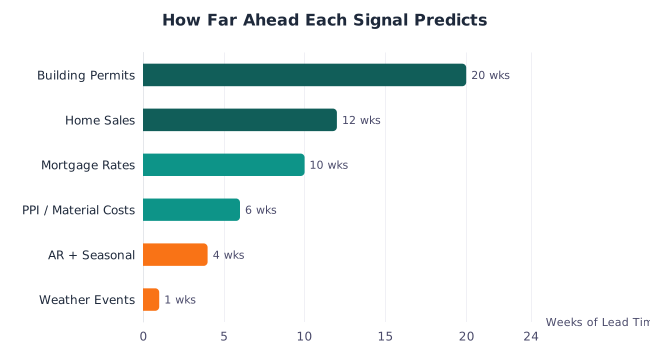
The housing market is the single strongest predictor of future demand for home services. Every home sale, every building permit, every mortgage rate change ripples through your business months later. The data is public, updated monthly, and shockingly accurate.
Here's what to watch and why.
Home sales volume predicts service calls. When home sales in your area increase 15% or more, expect a 12-15% increase in service calls within 3 months. New homeowners discover problems the seller hid. They want upgrades. They schedule inspections. More homes changing hands means more work for you, on a predictable delay.
Building permits predict install demand. Permits are even more leading than home sales because they precede construction by months. When building permits rise in your county, new construction demand is coming in 3-6 months. For HVAC contractors, that's system installs. For plumbers, rough-in work. For electricians, full panel and wiring jobs.
Track permits through the U.S. Census Bureau's Building Permits Survey or the Federal Reserve's FRED database. Updated monthly, free.
Mortgage rates predict everything downstream. When 30-year mortgage rates drop, home sales increase within 2-3 months. More sales mean more service calls. Lower rates also unlock renovation spending because homeowners refinance and pull equity for projects they've been putting off. When rates rise, the opposite happens. The Federal Reserve publishes this data weekly.
Inventory declining + prices rising = sustained renovation demand. When there aren't enough homes for sale and prices keep climbing, homeowners stop moving and start renovating. They can't find a new house they can afford, so they invest in the one they have. This creates sustained demand for remodeling, upgrades, and system replacements that lasts as long as the tight market does.
Sale-to-list ratio above 1.0 = bigger proposals get approved. When homes sell above asking price, homeowners have strong equity positions. They feel wealthier. They're more willing to say yes to the $8,000 water heater upgrade instead of the $3,000 repair. Track this through Redfin's free data center (updated monthly by metro and zip code).
The housing market doesn't just affect your business. It IS the demand engine for home services.
Weather Signals: Your 24-72 Hour Demand Predictor
Weather doesn't just affect whether your crews can work outside. It directly creates demand for specific trades on specific timelines. And unlike housing data, weather signals move fast.
3+ consecutive days above 90°F: HVAC failures spike. AC systems can handle a hot day. They struggle with sustained heat. After day 3 of a heat wave, AC repair demand increases by approximately 35%. The compressors run nonstop, capacitors fail, refrigerant leaks worsen. If you're an HVAC contractor and you see a 5-day heat streak in the forecast, staff up. The calls are coming on days 3 through 7.
Freeze after a warm spell: burst pipe calls in 24-72 hours. The freeze-thaw cycle is the number one cause of burst pipes. It's not just cold weather. It's the transition from warm to freezing that does the damage. When your area goes from 55°F to 18°F in 48 hours, pipes that expanded in the warmth contract and crack in the cold. Plumbers should watch for these transitions, not just cold snaps.
Hail events of 1 inch or larger: roofing claims arrive in 3-4 weeks. A single hailstorm can create six months of backlog for roofers in a metro area. But the work doesn't show up immediately. Insurance claims take 2-4 weeks to process. If you're a roofer and a significant hail event hits your area, start planning capacity now. The wave is coming, and it's predictable down to the week.
Heavy rain over 2 inches in 24 hours: sump pump and drainage calls within 48 hours. Plumbers know this intuitively, but the data confirms it. Heavy rain events drive immediate demand for sump pump repairs, basement drainage, and water intrusion calls. The timeline is tight: 24-48 hours after the event.
Extended heat waves: electrical panel overloads. When everyone runs their AC at full blast for days, the electrical grid strains. Individual homes experience breaker trips, panel overloads, and in older homes, wiring failures. Electricians should expect emergency calls during and immediately after sustained heat events.
You can pull weather data from NOAA's National Weather Service API (free, no key required) and historical storm reports from Iowa Environmental Mesonet. FEMA's disaster declarations API (free, no key) tells you when events cross the threshold into major demand spikes.
Economic Signals: Your 1-3 Month Pricing and Demand Warning System
Economic indicators feel abstract until you realize they directly predict whether your customers will say yes or no to proposals, whether your costs are about to jump, and whether the labor market is about to squeeze you.
Producer Price Index (PPI) rising = raise your prices. The PPI tracks wholesale costs for specific materials. The Federal Reserve publishes PPI data for plumbing fixtures, HVAC equipment, electrical equipment, and broad construction materials. When these indices rise, material costs are going up market-wide. If you don't raise your prices, your margins compress.
Here's the insight most contractors miss: if PPI rose 5% but your material costs only rose 2%, you're either negotiating well with suppliers or absorbing increases without passing them to customers. Both are worth knowing.
Construction wages rising + employment flat = labor market squeeze. When the Bureau of Labor Statistics reports rising hourly earnings for construction workers but flat employment numbers, the labor market is tight. Everyone is competing for the same workers. If you haven't adjusted your labor rates in the last 6 months, your margins are being compressed by forces outside your control.
Consumer confidence declining = discretionary projects dry up. The University of Michigan Consumer Sentiment Index measures how willing people are to spend money. When it drops, homeowners delay the kitchen remodel, the bathroom upgrade, the "nice to have" electrical work. They still call for emergencies. They still fix the burst pipe. But the $15,000 proposals sit unsigned.
When you see consumer confidence dropping, shift your marketing toward emergency and essential services. Don't waste ad spend on luxury upgrades when nobody's buying.
Mortgage rates rising = fewer home sales in 2-3 months. This is the reverse of the housing signal above. Rising rates cool the housing market, which means fewer home sales, which means fewer new homeowners discovering problems. The effect takes 2-3 months to show up in your call volume, but it's coming.
Track these through FRED (free API, just register for a key) and the Bureau of Labor Statistics (free, updated monthly). The data updates monthly.
Your Own Data as a Leading Indicator
External signals tell you what's happening in the market. Your own data tells you whether your business is responding normally or if something internal is broken. The key is knowing what "normal" looks like for your trade, in your market, at this time of year.
Seasonal pattern breaks are the clearest internal signal. Every trade has predictable seasonal patterns. HVAC peaks in July-August and January-February. Plumbing spikes in January-March (frozen pipes) and November-December (holiday drain clogs). Roofing peaks May through August. General contracting dies in November through February in cold climates. (For the full breakdown of how these patterns differ across all five trades, including what "normal" looks like for each one, see our trade comparison.)
If your revenue is 25% below your seasonal average when it should only be 10% below, something operational is wrong. It's not the season. It's you. Maybe your marketing stopped working. Maybe a key employee left. Maybe your Google reviews dropped. The seasonal baseline tells you when to worry and when to relax.
Accounts receivable growing + seasonal slowdown approaching = cash crunch incoming. This is the combination that kills contractors. You have $18,000 in overdue invoices, and your slowest month is three weeks away. Revenue is about to drop 35% because that's what November does for general contractors. If you don't collect aggressively right now, you're going to be short on cash when you need it most. (43% of contractors deal with this pattern repeatedly.)
Customer concentration shifting is a silent risk. If one customer quietly grew from 15% of your revenue to 30%, you have a concentration problem you might not notice until they leave. If any single customer exceeds 25% of total revenue, that's a red flag worth addressing before it becomes a crisis.
Average ticket declining while revenue stays flat. You're doing more work for less money. Your revenue looks fine on the surface, but you're running harder to stay in place. This usually means you're taking on lower-margin work, your pricing hasn't kept up with costs, or your service mix shifted toward smaller jobs. Catch it early, fix it before it compounds.
The Multi-Signal "Something Is Wrong" Patterns
The real power comes from combining internal and external signals. Any single indicator can be noise. Multiple signals pointing the same direction is a pattern you need to act on.
Revenue down + weather should be driving demand up + competitors growing. Your revenue dropped 15% this month. But there was severe weather that typically drives demand UP for your trade. And Census County Business Patterns data shows 9 new competitors entered your county this year. You're not in a slow market. You're losing market share. Time to review your response time, pricing, and online presence.
Revenue up + margins down + PPI flat. Revenue grew 12% but gross margin dropped 4 points. Material costs haven't changed (PPI is flat). So you're either taking on lower-margin work, experiencing labor inefficiency, or under-pricing new jobs. The external data rules out market forces. The problem is internal.
Revenue below seasonal expectation + no weather or market explanation. Your revenue is 25% below the seasonal average for plumbing in January. Normally you'd expect about a 10% dip. There's no weather event, no market shift, no economic change that explains it. Something operational broke. Marketing, staffing, reputation, pricing. Investigate now, not in March when tax time forces you to look at the numbers.
Revenue above seasonal expectation + FEMA disaster declaration. Your revenue jumped 40% in a month where seasonal patterns predict only 10% growth. A FEMA disaster was declared in your county for severe storms. Mystery solved. But more importantly: expect sustained elevated demand for 4-6 weeks as insurance claims process and restoration work continues. Staff up, don't assume it's a one-week spike.
What This Looks Like in Practice
Here are real examples of how combining these signals produces insights no spreadsheet or dashboard can give you.
Example 1: The HVAC contractor who should be hiring.
Signals: Building permits in the county up 22% (FRED data). Mortgage rates dropped from 6.8% to 6.1% over the past quarter. Home sales volume up 18% (Redfin data). Consumer confidence stable.
Insight: "Three separate demand signals are pointing up. New construction installs are coming in 3-6 months from the permit surge. Service calls from new homeowners will increase within 90 days from the home sales spike. And homeowners have equity and confidence to approve upgrades. If you don't have capacity to handle a 15-20% volume increase by Q3, start hiring now."
Example 2: The plumber who shouldn't panic.
Signals: Revenue down 12% month-over-month. But it's February in Colorado. Seasonal benchmark says plumbing typically dips 8-12% in late February as the freeze season winds down. No weather anomalies. Housing market stable.
Insight: "Your revenue dip is within normal seasonal range. This isn't a problem to solve. It's a pattern to expect. Focus on marketing for spring (sump pump maintenance, outdoor faucet repairs, water heater flushes) to capture the March uptick."
Example 3: The roofer who needs to prepare for a wave.
Signals: 2-inch hail reported 12 miles from the shop (NOAA storm reports). FEMA monitoring the event. Insurance claim processing typically takes 3-4 weeks.
Insight: "Hail damage claims will start arriving in 3-4 weeks. Based on the storm's coverage area, expect 4-6 weeks of elevated replacement demand. Order materials now while supply is normal. If this escalates to a FEMA declaration, demand could stay elevated for 2-3 months across all trades."
Example 4: The electrician facing margin pressure.
Signals: PPI for electrical equipment up 6.2% year-over-year. Customer's material costs up only 3%. Gross margin declined from 52% to 48% over two quarters. Construction wages in the metro up 4.8% (BLS data).
Insight: "Your margins are being compressed from two directions. Material costs rose 6.2% industry-wide but you only passed through half of that. Meanwhile, labor costs rose 4.8% in your market. Combined, that's over 10% in cost pressure you haven't fully priced for. A rate increase isn't optional. It's overdue."
Example 5: The GC who's about to hit a wall.
Signals: Consumer confidence dropped from 71 to 62 over two months. Mortgage rates rising. Home sales declining. Customer's AR balance growing. November (slowest month) is 4 weeks away.
Insight: "Multiple signals point to softening demand. Consumer confidence is dropping, which means discretionary renovation projects will slow. Your AR balance grew $14,000 this month, and your slowest season starts in 4 weeks. Collect aggressively on outstanding invoices now. Shift marketing toward essential repairs and maintenance rather than large renovation proposals."
The Data Sources That Make This Possible
Every signal mentioned in this post comes from free, public data:
- FRED (Federal Reserve Economic Data): Housing starts, building permits, mortgage rates, PPI by material type, consumer confidence, construction wages. Free API key, updated monthly.
- Redfin Data Center: Home sales volume, median prices, days on market, sale-to-list ratios. Free CSVs by metro and zip code, updated monthly.
- NOAA National Weather Service: Forecasts, historical weather, storm reports. Free API, no key required.
- FEMA OpenFEMA: Disaster declarations by county, disaster type and date. Free API, no key required.
- Bureau of Labor Statistics: Construction employment, hourly earnings, unemployment by metro. Free API, updated monthly.
- EIA (Energy Information Administration): Electricity and natural gas prices by state. Free API, updated monthly.
- Census ACS (American Community Survey): Housing age, owner-occupied rates, median income, population trends. Free API, updated annually.
- Census County Business Patterns: Competitor counts by trade and county. Free, updated annually.
The data is there. The challenge is connecting it to your specific business, in your specific market, on a timeline that's actually useful.
Stop Finding Out After the Fact
Bad months don't appear out of nowhere. They're preceded by signals that most contractors never see because they're buried in public databases nobody in this industry thinks to check.
Housing market shifts predict your demand 3-6 months out. Weather patterns predict emergency call volume 24-72 hours out. Economic indicators predict pricing pressure 1-3 months out. Your own seasonal patterns tell you when a dip is normal and when something is actually broken.
The contractors who see these signals coming have time to prepare. They hire before the rush. They raise prices before margins compress. They collect receivables before cash gets tight. They shift marketing before demand softens.
The ones who don't find out on a Tuesday when they check their bank account.
Streett Reports doesn't just tell you what happened last week. It connects your QuickBooks data to housing market trends, weather patterns, and economic indicators to tell you what's coming next. Every Monday morning, in plain English.
Your first report is free, no credit card required.
Or see what predictive insights look like: Plumbing | HVAC | Roofing
See what this looks like for YOUR business
Connect your QuickBooks in about 2 minutes. Your first report is free.
Get Your Free Report →