The 43% Problem: Why Most Contractors Run Out of Cash (And the Weekly Habit That Fixes It)
43% of small businesses report cash flow as a persistent problem. For contractors, seasonal swings and slow-paying customers make it worse. Here's the weekly habit that prevents cash crises before they start.
On this page
- Why Cash Flow Is Uniquely Hard for Contractors
- The Three Patterns That Predict a Cash Crunch
- The Real Cost of Cash Flow Problems
- The Weekly Habit That Fixes It
- What Each Number Tells You (And What Action It Drives)
- The Compound Effect: How Weekly Visibility Prevents Problems From Compounding
- Start This Monday
You've had the month. Maybe it was February. Maybe it was November. Revenue dropped, but payroll didn't. Materials you bought last month came due. A customer who owes you $12,000 hasn't returned your calls. You're staring at your bank balance wondering how a business that did $80K last month is now scrambling to cover a $6,000 equipment payment.
You're not alone. 43% of small businesses report cash flow as a persistent, recurring problem. Not a one-time surprise. A pattern that repeats, year after year, eroding margins and creating stress that never fully goes away.
And it's getting worse. 74% say their cash flow situation has either worsened or stayed the same over the past year.
For contractors, these numbers understate the problem. The way contracting works, with seasonal demand, slow-paying customers, and the gap between doing work and getting paid, makes cash flow harder to manage than almost any other small business model.
But cash crises don't appear overnight. They build over weeks. And the contractors who never get caught off guard share one habit in common. They check five numbers every Monday morning. That's it. Five minutes, five numbers, every week.
Let's break down why cash flow hits contractors so hard, what patterns predict a crunch before it arrives, and how a simple weekly habit prevents the problem entirely.
Why Cash Flow Is Uniquely Hard for Contractors
Most small businesses have cash flow challenges. Contractors have cash flow challenges on hard mode. Here's why:
Seasonal demand swings are brutal. HVAC companies see revenue drop 30-60% from peak during shoulder months. General contractors experience a 35% drop between October and November alone. Plumbers face their danger zone in late fall when residential remodel work dries up and new construction pushes toward completion. Your revenue isn't steady; it's a roller coaster. But your fixed costs, rent, insurance, vehicle payments, office staff, ride along at the same level all year. The good news: these seasonal patterns are predictable if you know what signals to watch.
You pay now, get paid later. This is the fundamental cash flow trap for contractors. You buy materials and pay labor the week you do the work. Your customer pays you 30-45 days later. The industry target for days-to-payment is 14-21 days. Most contractors are running at 30-45 days. That gap means you're financing your customers' projects with your own cash, every single month.
Margins are thinner than they look. A general contractor running 35-45% gross margins has almost no buffer. One slow month can undo three good ones. When your net margin is 8-15% and your revenue drops 35% in a single month, the math gets ugly fast.
Weather doesn't care about your overhead. A week of rain delays outdoor projects. An unseasonably warm winter kills heating demand. A mild summer reduces AC emergencies. You can't control when the work comes in, but your bills arrive on schedule regardless.
The Three Patterns That Predict a Cash Crunch
Cash crises feel sudden, but they're not. They follow predictable patterns that show up weeks before the crisis hits. If you know what to look for, you can act before the problem becomes an emergency.
Pattern 1: AR Growing + Seasonal Slowdown Approaching
This is the number one cash flow killer for contractors. Your accounts receivable balance is climbing (customers owe you more and more), and your slowest season is approaching.
Here's what it looks like: You have $18,000 in overdue invoices. November, your slowest month, is three weeks away. Revenue is about to drop 35%. If you don't collect aggressively right now, you'll enter your slowest month with less cash than you need and fewer new invoices coming in to replenish it.
$18K overdue + slowest month 3 weeks away = collect NOW.
The fix is obvious once you see it. But most contractors don't see it because they're not tracking AR aging alongside their seasonal calendar.
Pattern 2: High Revenue + Low Collection Rate
This one is sneaky. You just had a great month. $85,000 in revenue. You feel good. But your AR balance also grew by $12,000. You did the work, but you didn't get paid. Your average days-to-payment crept from 28 to 37 days.
Revenue means nothing if it's stuck in receivables. A high-revenue month with poor collections is actually worse than a moderate month with tight collections, because you spent more on labor and materials to generate that revenue, and now you're waiting longer to recoup it.
Pattern 3: Seasonal Transition Without Reserves
The rule of thumb is simple: set aside 10-15% of peak-month revenue into a reserve account. If your best month generates $120,000, you should have $12,000-$18,000 in reserves specifically earmarked for your slow season.
Most contractors don't do this. They spend peak-month revenue on equipment, hiring, or catching up on deferred expenses. Then the slow season arrives and there's no cushion.
The pattern: strong summer, no reserves built, October hits, and suddenly you're choosing between making payroll and paying your materials supplier.
The Real Cost of Cash Flow Problems
Cash flow problems don't just create stress. They compound into real business damage:
Missed growth opportunities. A commercial contract comes up that would add $200K in annual revenue. But it requires $30K in upfront materials and you don't have the cash. You pass. Your competitor doesn't.
Emergency borrowing at terrible rates. A line of credit at 8% is fine when planned. A merchant cash advance at 40%+ effective APR because you need $15K by Friday is a margin destroyer. Contractors in cash crunches make expensive financing decisions because they don't have time to shop for better options.
Inability to hire when you need to. Your best tech gets an offer from a competitor. You'd match it, but cash is tight this month. You lose a $150K-per-year revenue generator because you couldn't find $5K in the budget for a raise.
Stress that bleeds into everything. You're not sleeping well. You're short with your crew. You're making reactive decisions instead of strategic ones. The business owns you instead of the other way around.
Supplier relationship damage. Pay a supplier late twice and you lose your net-30 terms. Now you're paying COD, which makes your cash flow even worse. It's a downward spiral.
The common thread: every one of these problems was preventable with earlier visibility. Not more money. Just earlier awareness that the problem was building.
The Weekly Habit That Fixes It
Here's what separates contractors who get blindsided from those who don't: a 5-minute financial check every Monday morning.
Not a dashboard you never look at. Not a spreadsheet you update quarterly. Not a meeting with your accountant once a month. A simple, consistent habit of reviewing five numbers at the start of every week.
The contractors who do this catch problems 3-4 weeks before they become crises. That's the difference between "I need to follow up on collections this week" and "I can't make payroll on Friday."
Five minutes. Five numbers. Every Monday. That's the entire system. (We break down exactly which numbers to check and how to pull them in The Monday Morning Financial Check.)
What Each Number Tells You (And What Action It Drives)
1. Cash Position: What's in the Bank Right Now
This is your starting point. Not your revenue. Not your projected income. What is actually in your operating account this morning?
What it tells you: How many weeks of operating expenses you can cover without any new money coming in. If the answer is less than three weeks, you're in the danger zone.
Action it drives: If cash position is dropping week over week, something is wrong. Either collections are slow, expenses spiked, or revenue is declining. You don't need to know which one yet. You just need to know it's happening so you can investigate before it becomes critical.
2. AR Balance: What's Owed to You, and How Much Is Overdue
Your total accounts receivable, broken into current (under 30 days) and overdue (over 30 days). The overdue number is the one that matters most.
What it tells you: How much cash is "out there" that should be in your bank account. If your overdue balance is growing, your future cash position is at risk.
Action it drives: When overdue AR crosses a threshold you're uncomfortable with, it's time to pick up the phone. Not send another email. Call. Specifically, call the largest overdue invoice first. One phone call on Monday morning can move $8,000 from "overdue" to "deposited" by Friday.
3. Revenue vs. Seasonal Average: Are You Tracking Above or Below Normal
This is where context matters. Revenue being down 20% in January might be perfectly normal for an HVAC company (heating season is strong, but not peak). Revenue being down 20% in July is a five-alarm fire.
What it tells you: Whether your current trajectory is normal for this time of year, or whether something unusual is happening that needs attention.
Action it drives: If you're below seasonal average with no weather or market explanation, something operational is off. Marketing, pricing, capacity, close rate. If you're above average, great, but make sure you're collecting on that extra revenue, not just generating more AR.
4. Upcoming Obligations: What's Due This Week
Payroll. Materials invoices. Loan payments. Insurance premiums. Equipment leases. What cash is going OUT in the next 7-14 days?
What it tells you: Whether your current cash position can cover what's coming. Simple subtraction: cash in bank minus obligations due. If the result is negative or uncomfortably close to zero, you need to act today.
Action it drives: When obligations exceed available cash, you have three levers: accelerate collections (call overdue customers), delay non-critical payments (negotiate with suppliers), or tap a credit line before you need it desperately. All three are easier on Monday than on Thursday when payroll is due Friday.
5. Trend Direction: Are Things Getting Better or Worse vs. Last Week
This is the compound-effect number. Is your cash position higher or lower than last Monday? Is your AR balance growing or shrinking? Is revenue trending up or down relative to seasonal norms?
What it tells you: Whether your current trajectory leads somewhere good or somewhere bad. A single bad week isn't a crisis. Three consecutive weeks of declining cash position and growing AR is a pattern that demands immediate action.
Action it drives: When trends are negative for two or more consecutive weeks, escalate your response. Move from "I should follow up on collections" to "I'm calling every overdue customer today and offering a 2% discount for payment this week."
The Compound Effect: How Weekly Visibility Prevents Problems From Compounding
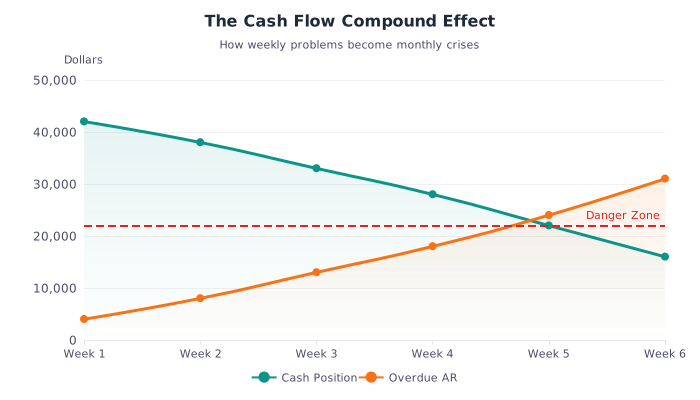
Here's why weekly matters more than monthly: problems compound.
Week 1: AR grows by $4,000. No big deal. Week 2: AR grows by another $6,000. Still manageable. Week 3: AR grows by $5,000. Now you're $15,000 behind on collections and your slow season starts in two weeks.
If you check monthly, you discover a $15,000 problem all at once, with less time to fix it. If you check weekly, you catch it at $4,000 and make one phone call.
The same applies to every metric. Revenue trending 10% below seasonal average for one week is noise. Three weeks in a row is a signal. Cash position dropping $3,000 per week for four weeks is a $12,000 problem that started as a $3,000 observation.
Weekly visibility turns crises into course corrections. You're never surprised. You're never scrambling. You're making small adjustments every Monday instead of emergency decisions every quarter.
This is how you exit the 43%. Not by making more money. Not by finding better customers. Not by eliminating seasonality (you can't). By seeing problems early enough to solve them while they're still small.
Start This Monday
You don't need special software to build this habit. You can pull these numbers from QuickBooks manually. You can track them in a notebook. The format doesn't matter. The consistency does.
What matters is that every Monday morning, before you dispatch your first tech or drive to your first job site, you spend five minutes with these five numbers. Cash position. AR balance. Revenue vs. seasonal norm. Upcoming obligations. Trend direction.
Do it for four weeks and you'll wonder how you ever ran your business without it.
Streett Reports delivers your weekly cash flow check automatically. Every Monday morning, you'll know your AR balance, overdue amount, days-to-payment trend, and seasonal position. In plain English, with specific action items when something needs attention.
Your first report is free, no credit card required.
Or see what weekly cash flow visibility looks like: Plumbing | HVAC | General Contracting
See what this looks like for YOUR business
Connect your QuickBooks in about 2 minutes. Your first report is free.
Get Your Free Report →