27 Private Equity Firms Are Hunting Your Competitors. Here's What They Pay For.
Private equity is rolling up home services. Their buying criteria tell you what makes a contracting business valuable: clean data and recurring revenue.
On this page
The Buyers Showed Up With Real Money
In February 2026, Blackstone bought Champions Group. The reported price was about $2.5 billion, which industry analysts pegged at roughly 18.5x EBITDA (HireBloom). For an HVAC and plumbing platform. Not a software company, not a biotech startup. A home services business, the same kind of business you run.
That deal is the loud one, the headline number. The quieter story is that 27 active HVAC-led roll-up platforms are competing for deals right now, according to HireBloom. Twenty-seven well-funded buyers, all looking for contracting businesses to acquire, all running the same scoring model on every shop they evaluate.
You may never sell. Most contractors won't, and this post isn't telling you to. But the criteria those 27 buyers use to separate a premium acquisition from a pass is the single best definition of business quality you'll find anywhere. They've spent billions stress-testing it. What they pay top dollar for is exactly what makes your business stronger, more profitable, and easier to run, whether you sell it next year or hand it to your kid in twenty.
So let's look at the playbook.
What Changed in 2026
Private equity used to buy home services businesses to build big national brands. Plant a flag, slap one name on a hundred trucks across thirty states, call it a platform. That phase is over.
The strategy shifted to local geographic density and tech integration, per CFOx Advisory. Buyers now want to own a metro, not a map. They acquire 10 to 15 shops inside a tight radius, share trucks and dispatch across all of them, and cut the wasted windshield time that eats a contractor's margin alive. Tighter routes mean more billable hours per tech per day. That's the whole game.
What that shift means for you: density-and-tech buyers care about data more than the old flag-planters ever did. When a buyer plans to fold your shop into a shared dispatch system on day one, they need your numbers to plug in clean. If your books are a mess, you're not a quick integration. You're a cleanup project. And cleanup projects get discounted.
There's a demand tailwind under all of this too. The median age of an American home passed 40 years. Half the housing stock is now in the high-maintenance zone, the age where systems fail and replacements come due. Buyers see a decade of steady repair and replacement demand baked into the housing itself. That's part of why the money is moving.
The Two Things They Actually Pay For
Strip away the jargon and the buying criteria come down to two questions. How predictable is your revenue, and how trustworthy is your data. Get both right and you're a premium asset. Miss either one and you're a discount.
Recurring revenue, and the 15% cliff
Buyers obsess over the share of your revenue that repeats on its own. Maintenance agreements, service memberships, subscription plans. The income that shows up whether or not the phone rings this week.
For the top-quartile PE-backed firms, membership and subscription revenue runs around 28% of total revenue. That's the benchmark the best operators hit. It's the floor under their cash flow, the reason their numbers don't crater in a slow month.
Now the part that should get your attention. If your recurring revenue sits below 15% of total, buyers classify the business as "high-volatility" and either discount the price hard or walk away entirely. Below 15% and you're not in a negotiation about how much. You're in a question of whether they bid at all. Every dollar of your revenue has to be re-earned from scratch every month, and a buyer prices that uncertainty straight into the offer.
A contractor running 5% recurring revenue and a contractor running 28% can do identical work, bill identical totals, and run identical crews. One gets a premium offer. The other gets a polite pass. The difference is nothing a customer would ever see. It lives entirely in the revenue mix.
Clean, verifiable data
The second thing is your books, and this is where most shops bleed value without ever knowing it.
A buyer planning to integrate your shop into a shared platform needs to verify your financials fast. They want to see, in your actual QuickBooks, that revenue is categorized correctly, that recurring revenue is tracked separately from one-off jobs, that the P&L reconciles to the tax returns, that there aren't twelve months of expenses dumped into "miscellaneous." If you can't feed real-time, accurate data into their dashboard, you go in the discount pile. The CFOx outlook calls this the fixer-upper problem: a shop whose data can't be trusted is priced like a house that needs a new roof.
This is the part you control completely, starting today, for free. You don't need to add a single maintenance contract to clean up how you categorize the ones you already have. The shop with three years of clean, consistent books reads as low-risk. The shop with a shoebox of receipts and a P&L nobody trusts reads as a gamble, and buyers don't pay premium prices for gambles.
The K-Shaped Market
Put those two factors together and you get what analysts are calling a K-shaped valuation market. The quality assets and the weak ones are splitting apart, and the gap between them keeps widening.
Quality businesses, the ones with strong recurring revenue and clean verifiable data, are trading at 10 to 12x EBITDA. The weaker assets sell at steep discounts, when they sell at all. Same trade, same region, wildly different outcomes. There's no longer a comfortable middle. You're on the top arm of the K or the bottom one.
Here's what that split is worth in real dollars.
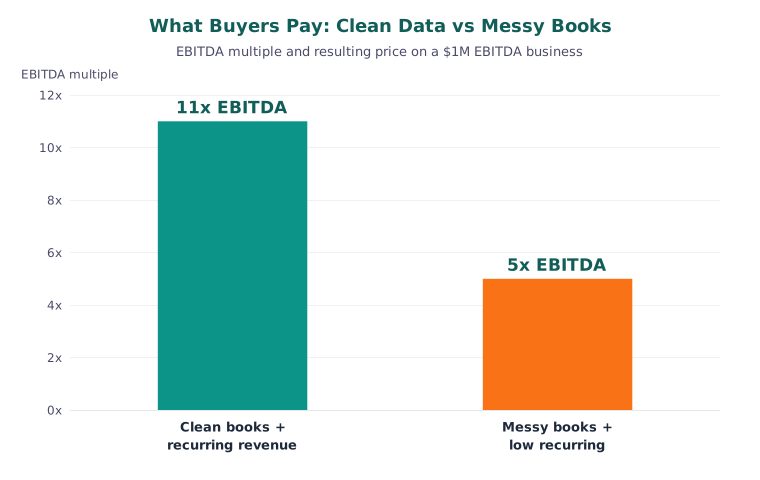
Take a contractor with $1 million in EBITDA. On the strong arm of the K, at 11x, the business is worth $11 million. On the weak arm, at 5x, the same $1 million in earnings is worth $5 million. Six million dollars of difference on identical profit. Not because one business makes more money. Because one business proved its money was predictable and its books were real, and the other couldn't.
That $6 million isn't a reward for working harder. It's a reward for measuring and managing two specific things over the years leading up to the sale.
What Each Trade Actually Trades For
The headline roll-up multiples (10 to 12x for the cream, 18.5x for a Blackstone-sized platform) are the top of the market. They apply to large, polished, multi-location operations. Your local shop lives in a different range, and that range depends heavily on your trade and whether you carry contracts.
| Trade | Typical EBITDA Multiple | What Moves It |
|---|---|---|
| HVAC (with maintenance contracts) | 5-8x | Recurring revenue, replacement cycle |
| HVAC (without contracts) | 2-4x | Seasonal, project-dependent |
| Plumbing | 2.9-5x | Essential service, aging housing |
| Electrical | 3-5x | Code-driven, steady demand |
| Roofing | 2-4x | Weather-driven, project-based |
| General Contracting | 2-3.5x | High competition, thin recurring |
Look at the HVAC rows. With contracts, 5 to 8x. Without, 2 to 4x. Same trade, and the multiple doubles purely on recurring revenue. That's the 15% cliff and the 28% benchmark showing up in your own backyard, not just in billion-dollar Blackstone deals. (We broke down the contract economics in detail in the maintenance contract math, and the full breakdown of how multiples work lives in what your business is actually worth.)
Plumbing and electrical sit in steadier ranges because the demand is less seasonal and the work is essential. Roofing swings on weather. General contracting trades lowest because the barriers to entry are low and recurring revenue is rare. None of these are destiny. A plumbing shop at the top of its 2.9-5x range, with clean books and a growing membership base, beats an HVAC shop sitting at the bottom of its range with no contracts and messy financials.
Why This Is Your Operating Plan, Sale or No Sale
Forget the exit for a second. Every criterion on the buyer's checklist is also a description of a business that runs better and pays you more right now.
Recurring revenue smooths your cash flow through the slow months, the March and October valleys where HVAC shops without contracts start sweating payroll. It raises retention, because members don't price-shop your competitors. It feeds your replacement pipeline, because the tech doing a tune-up is the one who spots the dying system and books the $8,000 job. The recurring revenue percentage that wins a premium multiple is the same number that keeps you solvent in February.
Clean data does the same double duty. Three years of accurate books isn't a thing you scramble to build in the six months before listing. It's a weekly discipline that, along the way, tells you which jobs actually make money, where your margins are slipping, and which customer is creeping toward 25% of your revenue. (That last one is its own risk, and we covered it in customer concentration risk.) Catching a miscategorized expense this week takes thirty seconds. Untangling 300 of them at year-end costs you real money in accountant hours and, if a buyer ever shows up, real money in their discount.
The contractors who land on the top arm of the K aren't the ones who got lucky. They're the ones who knew their recurring revenue percentage and their margin trend every single week for years, and ran the business off those numbers. The premium multiple is just the scoreboard at the end. The actual prize was a better-run, more profitable business the whole time they owned it.
You don't need 27 private equity firms to want your shop for any of this to pay off. You just need to know the two numbers they'd grade you on, and watch them like they do.
Streett Reports reads your QuickBooks every week and tells you, in plain English, what your recurring revenue percentage is, where your margins are moving, and whether your books would hold up to a buyer's scrutiny. Buyer-ready isn't a project you start before a sale. It's a number you keep clean from now on.
Your first report is free, no credit card required.
See what this looks like for YOUR business
Connect your QuickBooks in about 2 minutes. Your first report is free.
Get Your Free Report →