The $2,000 Cylinder: How the Refrigerant Transition Is Eating HVAC Margins
Refrigerant and equipment costs spiked during the A2L transition. If your install pricing still reflects 2021, you're eating the difference.
On this page
You priced a 3-ton changeout at $9,800 two summers ago and it felt like a fair number. Good margin, competitive bid, customer said yes. So you kept quoting it.
The job costs more now. Not a little more. The equipment went up, the refrigerant in it went up, and the freight to get it to your shop went up. If the price on your proposal template hasn't moved to match, the gap is coming straight out of your margin. You're still booking the work. You're just keeping less of it.
This is the kind of slow leak that never shows up as a crisis. No single job loses money in a way you'd notice. The damage shows up at year-end when revenue looks fine and the profit isn't there. Let's walk through what actually changed, then how to check whether your pricing kept up.
What the A2L transition did to your cost of goods
The industry spent 2025 and 2026 phasing out R-410A in favor of A2L refrigerants like R-454B. Lower global warming potential, mandated timeline, no real choice about it. The trade learned the new line sets, the new leak detection rules, the new equipment. Most owners handled the technical side fine.
The cost side is where it got expensive.
One industry source reports that a cylinder of R-454B climbed from about $345 in 2021 to over $2,000 by 2026 (Simpro). Treat that exact figure as one data point from one source, not gospel. I'll come back to why you should verify it against your own invoices. Even if your distributor's number is half that jump, it's a brutal increase on a line item that goes into every install and every charged repair.
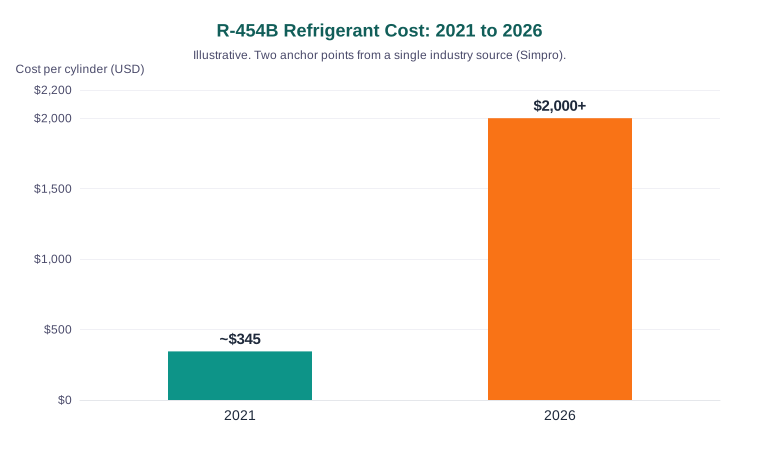
That chart is two anchor points from a single source, drawn as a straight line because nobody published a clean year-by-year series. The real path was bumpy, driven by supply constraints during the changeover. The direction is what counts, and the direction is straight up.
Equipment moved too. New A2L-compliant units run about 15 to 25 percent more than the R-410A models they replaced (HumiHeat). Pair that with a separate trend: HVAC systems that came in under $10,000 before 2020 now routinely cross that line (Money.com). And on top of the transition, major manufacturers announced across-the-board price increases for 2026, pointing to tariffs, the A2L switch, inflation, and supply chain disruption all hitting at once (GoPaschal).
Stack those together. Higher equipment cost, higher refrigerant cost, higher freight. Your cost of goods on a typical install is meaningfully heavier than it was when you wrote your current pricing.
Why this hits margin and not just price
A healthy HVAC business runs a gross margin around 50 to 55 percent. Install-heavy work already sits at the low end of that range, because equipment is a big chunk of the ticket and equipment doesn't carry the markup your labor does. Service and maintenance work runs richer, 55 to 65 percent, because you're selling expertise and time instead of a box.
Here's the mechanical problem with an equipment-heavy job. When the cost of the box goes up and your sell price stays flat, every dollar of increase comes out of gross profit at a one-to-one rate. There's no labor efficiency to absorb it. The compressor costs what it costs.
Run the numbers on a single changeout. Say the equipment and refrigerant on a job went up $900 over two years and your quoted price didn't budge. On a $9,800 ticket, that's nearly nine points of gross margin gone on that one job. Do forty installs a season at that gap and you've handed back $36,000 in gross profit. Nobody stole it. You priced it away one proposal at a time.
The trap is that installs feel like your big-money jobs. The ticket is large, so the work feels profitable. But a large ticket with a thin and shrinking margin can be less profitable than a well-priced service call. We dug into this gap between revenue and actual margin in How to Know If You're Charging Enough, and the refrigerant transition made it sharper for HVAC specifically.
The audit: is your install pricing current?
You don't need a consultant for this. You need an hour, your last few equipment invoices, and your current proposal template. Work through it in order.
Step 1: Pull your real landed cost on your three most common installs. Not last year's cost. Call your distributor or pull this month's invoices. Get the actual price you pay today for the equipment, the refrigerant charge, the line sets, the misc materials. Add freight if they bill it separately. This is your current cost of goods for that job.
Step 2: Find the price you're actually quoting. Open the proposal template or the last three signed contracts for that same job type. What number is going out the door right now?
Step 3: Calculate the real gross margin on today's numbers. Sell price minus your current landed cost minus your install labor, divided by sell price. That's your true gross margin on that job as it stands today. Compare it to the 50 to 55 percent benchmark. If you're sitting at 38 percent on installs you assumed were making 50, you found your leak.
Step 4: Check the date on your pricing. When did you last change the install price? If the answer is "sometime in 2024" or you genuinely can't remember, that's the tell. Refrigerant and equipment costs moved hard across 2025 and 2026. Pricing set before that move is pricing built on costs that no longer exist.
Step 5: Look at how you bill refrigerant on service. Installs aren't the only exposure. If you're charging by the pound at a rate you set when a cylinder was a few hundred dollars, every top-off on an older R-410A system and every charge on a new A2L system can be underwater. Reprice refrigerant per pound against what the cylinder costs you this week, with your markup on top.
Do this for your top three job types and you'll know within an hour whether you're current or bleeding.
What an honest repricing looks like
Catching the gap is the easy part. Closing it without scaring off customers takes a little more care.
Move your install pricing to hit your target margin on today's costs, not last year's. If your landed cost climbed $900 and you want to hold a 50 percent gross margin, the sell price needs to move more than $900, because margin is a percentage of the sell price, not a flat dollar add. A lot of owners add the cost increase straight onto the price and still come up short. Run the margin math, don't eyeball it.
Build the increase into the template so it sticks. A one-time mental note to "charge more" evaporates the next busy week when your comfort advisor grabs the old number. Change the actual default in your proposal tool.
Give your customers a reason, because there is a real one. The refrigerant transition is a documented, industry-wide change. You're not inventing a surcharge. "The federal refrigerant changeover raised equipment and refrigerant costs across the board in 2025 and 2026" is true, it's verifiable, and most homeowners have already heard something about it.
If a full repricing feels like too big a jump in one move, lean harder on the side of the business that already carries better margins. Service and maintenance run richer than equipment swaps, and they're more defensible on price because the customer is buying your expertise. Which is the bridge to the real fix.
The structural hedge: stop living on equipment margin
Repricing installs stops the bleeding. It doesn't fix the underlying exposure, which is that you're heavily dependent on a job type where most of the ticket is a commodity box whose price you don't control.
Maintenance revenue is the counterweight. It carries 55 to 65 percent gross margins, it's not exposed to equipment cost swings the way installs are, and it smooths the 25 to 40 percent seasonal revenue swing that defines HVAC. It also feeds your install pipeline. Customers on a maintenance plan convert to replacement jobs at three to five times the rate of cold leads, because your tech is already in the home with trust built.
That changes the install math in your favor. A replacement sold to a maintenance customer costs you almost nothing to acquire, while a replacement won off a cold "AC repair near me" lead carries real marketing cost on top of the thin equipment margin. Same box, very different profit. I broke the full model down in The Maintenance Contract Math, and the refrigerant squeeze makes the case stronger than it was a year ago.
The broader point holds across the trade. HVAC carries more volatility and more equipment exposure than plumbing or electrical, which is exactly why the financial discipline has to be tighter. We compared the three side by side in HVAC vs Plumbing vs Electrical: Financial Patterns if you want to see where your numbers should sit.
The number to watch every week
Install margin isn't a year-end number. It moves every time your distributor changes a price, and right now those prices are moving. The owners who get hurt are the ones who find out at tax time. The owners who stay ahead of it are checking gross margin by job type often enough to catch the drift while they can still adjust a proposal.
Pull your install margin this week. If it's holding at 50 to 55 percent on today's costs, good, you priced through the transition. If it slipped, you now know exactly which number to change and by how much. Either way you're no longer guessing, and guessing is the expensive option.
Streett Reports reads your QuickBooks data and tracks install margins, job-type profitability, and materials cost trends every week, so a refrigerant price hike shows up as a number you can act on instead of a surprise at year-end.
Your first report is free, no credit card required.
Or see what it looks like first: Sample HVAC Report →
See what this looks like for YOUR business
Connect your QuickBooks in about 2 minutes. Your first report is free.
Get Your Free Report →