Profitable But Broke: Why Contractors Run Out of Cash While Making Money
Your P&L says profit. Your bank says empty. Profit is accounting, cash is reality. Why profitable contractors go broke and how to see it coming.
On this page
You closed the books on a good month. Sixty grand in revenue, costs under control, the P&L shows a healthy profit. You feel like you earned a beer. Then Thursday rolls around, payroll is due Friday, and your operating account has $2,300 in it. You did everything right and you still can't cover a $9,000 payroll run.
If that sounds familiar, you're not failing at business. You're running into the oldest trap in contracting, and it has a name most owners never learned: the gap between profit and cash.
About 82% of small business failures cite cash flow problems as a key cause. That stat gets thrown around a lot, so treat it as directional rather than precise. But the direction is the part that should scare you. Businesses don't usually die because they lost money. They die because they ran out of cash while the books still looked fine.
Other widely cited small business research points the same way: roughly 38% run out of cash even though about 40% are reporting profits in their first three years. Treat the exact figures as directional, the same way you should treat the 82%. The pattern is what counts. Profitable on paper. Broke in the bank. Same companies.
Profit and cash are two different things
Most contractors use these words like they mean the same thing. They don't, and the difference is exactly what wrecks you.
Profit is an accounting measurement. It's revenue you've earned minus expenses you've racked up, counted in the period the work happened. Your accountant builds it on the accrual method, which means a job counts as revenue the day you finish it and send the invoice. Doesn't matter if the customer pays you today or in 90 days. On the P&L, the money is "yours" the moment you bill it.
Cash is simpler and meaner. Cash is what's actually in the bank right now, today, this minute. Money you can use to make payroll, buy copper, or cover the truck payment.
Your P&L tracks profit. Your bank account tracks cash. They almost never match, and for contractors the gap between them can swallow the whole business.
Why the gap is brutal for contractors specifically
Plenty of businesses deal with this. A software company books a sale and collects the credit card the same day. A restaurant gets paid before the food hits the table. Their profit and their cash move together, more or less.
Contracting works backwards. You spend first and collect last.
Think about a single job. You buy the materials up front. You pay your crew at the end of the week, in cash, every Friday, no exceptions. The job wraps, you send the invoice, and then you wait. The industry target for getting paid is 14 to 21 days. Most contractors are actually running 30 to 45 days, and a slow commercial client or a property manager can stretch you past 60.
So the money goes out in week one. The money comes back in week six. You're floating the cost of every job out of your own pocket until the customer finally pays. That float has a name too. It's called working capital, and contracting eats it alive.
Now stack a few jobs on top of each other. You finish job A and front the cash for job B before A pays. Then job C lands before B pays. Every new job you take digs the hole a little deeper, because you're always paying for the next one before you've collected on the last. Growth makes it worse, not better. The busier you get, the more cash you're fronting at any given moment.
That's the part nobody warns you about. A great month, the kind where you book a pile of new work, is the month most likely to drain your account. You spent more on labor and materials to do all that work, and none of it has come back yet.
A profitable month that goes cash negative
Let me show you the math, because seeing it once makes it stick.
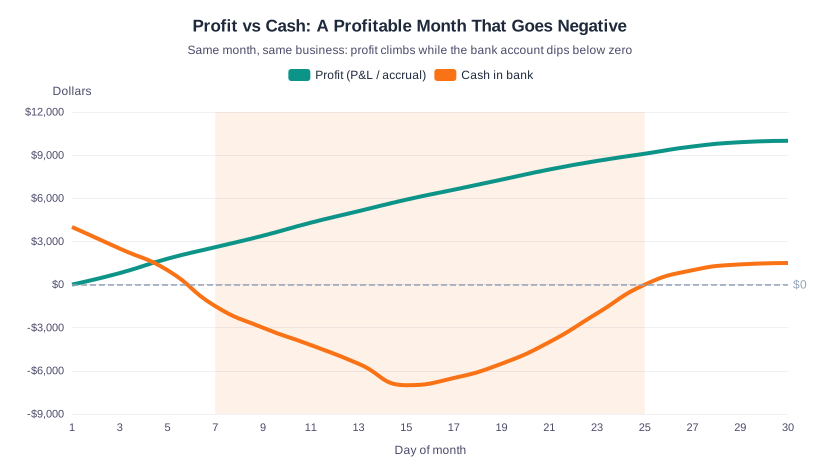
Say you run a plumbing shop. In June you do $60,000 of work. Your direct costs (field labor plus materials) run about $24,000, and your overhead (rent, insurance, trucks, software, your own pay) is another $26,000. Profit for the month: $10,000. A healthy 60% gross margin, a solid month.
Watch the cash, though.
Week one, you pull $7,000 for materials on three jobs and run $6,000 in field payroll. Week two, more materials, more payroll, and the monthly insurance and truck payments hit. By mid-month you've sent out close to $30,000 in real cash for work you've finished or are finishing. Your invoices went out too, so your P&L is climbing toward that $10,000 profit. Looks great in QuickBooks.
But the cash for those June invoices won't land until late July, because you're collecting in 40 days. The only money actually hitting your account in June is the collections from May's work. If May was a normal month, that covers some of June's costs. If May was slower, or if a couple of customers are dragging their feet, it doesn't.
So mid-June your bank balance dips below zero on paper, even though your profit line is solidly positive. That's the gap. Profit says you made ten grand. Cash says you're short and payroll is Friday. Both are true at the same time.
The business is healthy. The bank account is in crisis. And if you were only watching the P&L, you'd never have seen it coming.
The buffer most contractors don't have
You'd survive this easily with a fat reserve. Most shops don't have one.
The median small business holds about 27 days of cash buffer, according to JPMorgan Chase Institute research. Twenty-seven days. That's the cushion between you and a missed payroll if the money stops coming in. For a contractor running 30 to 45 day collections, your buffer is shorter than your own payment cycle. Let that sit for a second. You wait longer to get paid than you can afford to wait.
It gets tighter. Nearly two out of three small businesses have less than three months of operating cash if revenue slows down, according to Revenued's Q1 2026 report. And three in four say their costs are higher than they were a year ago. Materials, insurance, payroll, all up. So you're fronting more cash per job than you were last year, against the same thin buffer, waiting the same too-long stretch to collect.
This is why a contractor can have a record year on the P&L and still lie awake doing payroll math on a Thursday night. Profit grew. The cash gap grew right along with it.
What closes the gap
You can't fix this by working harder or booking more jobs. More jobs is more cash fronted. The fix is visibility, specifically visibility into the three things your P&L hides.
Your real cash position. Not revenue, not profit. The actual balance, today, and how many weeks of expenses it covers. If the answer is under three weeks, you're living inside that 27-day median and one slow-paying customer can tip you over.
Your accounts receivable, split by age. How much is owed to you, and how much of it is overdue. That overdue pile is your cash, sitting in someone else's account. A growing AR balance is the early warning that your cash gap is widening, weeks before the bank balance reflects it. We dug into how this shows up in your books in what your QuickBooks data is trying to tell you.
Your days-to-payment trend. If your average crept from 32 days to 41 days over the last two months, that's nine extra days you're financing every job for free. Nobody sends you an alert when that happens. It just slowly strangles you while the P&L keeps smiling.
None of this lives on a profit and loss statement. The P&L is built to measure profit, and it does that job. It was never designed to tell you whether you can make payroll on Friday. That's a different question and it needs different numbers.
Watch cash weekly, not monthly
Monthly is too slow for a cash gap. By the time you close the books on June and notice the squeeze, you're already in July living it.
The contractors who never get blindsided check their cash picture every week. Cash on hand. AR and how much is overdue. Days-to-payment moving up or down. It takes a few minutes, and it turns a surprise into a heads-up. You see the gap opening while it's small enough to close with one phone call to a slow-paying customer, instead of a frantic line-of-credit draw on a Thursday.
That weekly rhythm is the single habit that separates the shops that sleep at night from the ones that don't. We broke down the exact numbers to look at in the Monday morning financial check, and why the weekly cadence beats monthly in the 43% problem.
Pull the numbers from QuickBooks by hand if you want. A notebook works. The tool doesn't matter. What matters is that you stop treating your profit number as proof you're safe, and start watching the number that actually pays your people.
Profit tells you the work was worth doing. Cash tells you whether you'll still be in business next month to do more of it. Both are real. Only one of them covers payroll.
Streett Reports reads your QuickBooks data and emails you a plain-English weekly report showing your real cash position, your AR and overdue balance, and your days-to-payment trend, so the cash gap never sneaks up on you.
Your first report is free, no credit card required.
Or see what it looks like: Plumbing | HVAC | General Contracting
See what this looks like for YOUR business
Connect your QuickBooks in about 2 minutes. Your first report is free.
Get Your Free Report →