The Material Cost Spike Your January Bids Don't Account For
Construction input prices rose more in early 2026 than the prior 3 years combined. If you bid jobs in January and haven't repriced, you're losing money.
On this page
- You Bid That Job in a Different Economy
- More in Four Months Than the Last Three Years
- Where the Pain Actually Lives
- The Labor Side Isn't Helping
- How to Audit Your Pricing in an Afternoon
- Build In an Escalation Clause Going Forward
- Repricing Without Torching Your Close Rate
- What Weekly Tracking Would Have Caught
- The Window Is Now, Not at Year End
You Bid That Job in a Different Economy
Think back to a job you quoted in January. You priced the copper, the fittings, the flashing, the wire, whatever the work needed. You added your markup. The customer said yes. Maybe you're still working through that backlog right now.
Here's what changed while you were busy: the materials on that job cost a lot more today than they did when you wrote the number down. Not a little more. A lot.
If you haven't repriced since winter, you're eating the difference on every install. And the difference in 2026 is bigger than most contractors realize, because this wasn't normal inflation. It was an acceleration.
More in Four Months Than the Last Three Years
The Associated Builders and Contractors reported something that should stop you cold: construction input prices rose more in the first four months of 2026 than they did across the previous three years combined.
Read that again. Three years of cost creep, then four months that beat all of it.
That's the part that catches people. Contractors plan for inflation. You expect materials to climb a few points a year, so you nudge prices up a little each spring and call it even. That math works when costs rise on a gentle slope. It falls apart when costs jump a flight of stairs in one quarter, which is exactly what happened.
And it kept going. The AGC reported on June 11 that construction materials prices climbed in May at the highest rate since the pandemic. So this isn't a January problem you've already grown out of. The pressure was still building into late spring.
Where the Pain Actually Lives
"Materials went up" is too vague to act on. The increases aren't spread evenly, and the metals that hit home services hardest are the ones that moved the most.
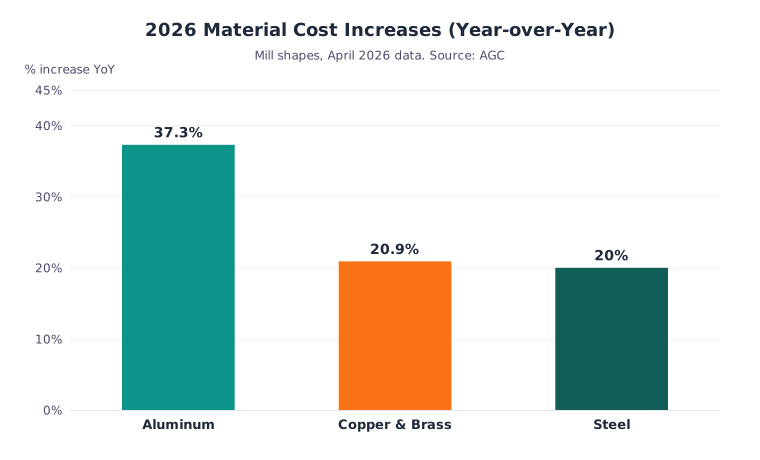
Here's what the AGC's April 2026 data shows, year over year:
- Aluminum mill shapes: up 37.3%. Flashing, gutters, coil stock, condenser coils, fittings. If you bend it, hang it, or wrap it, it costs a third more than it did a year ago.
- Copper and brass mill shapes: up 20.9%. Every plumber feels this one. Copper pipe, fittings, valves, brass bodies. The line items you buy by the box.
- Steel mill products: up roughly 20%. Conduit, strut, fasteners, ductwork, structural members. The backbone of electrical and HVAC rough-ins.
A plumber repiping a house with copper is buying material that's a fifth more expensive than the version they priced last summer. An HVAC tech replacing a system with aluminum coils and steel ductwork is getting hit on both metals at once. A roofer running aluminum flashing and drip edge is paying 37% more for the metal that keeps water out.
These aren't rounding errors on a quote. On a material-heavy install, a 20% to 37% jump on your biggest line items can erase your entire profit margin and then some.
The Labor Side Isn't Helping
Materials get the headlines, but labor is climbing too. Skilled trade labor costs are rising 4% to 6% year over year. Every hour your crew bills costs you more than it did last year, and that increase is steady, not seasonal.
So you've got two cost lines moving up at the same time. Materials spiking hard and fast. Labor grinding up a few points. If your bid is built on January's numbers for both, the gap between what you charged and what the job costs you is wider than you think.
How to Audit Your Pricing in an Afternoon
You don't need a consultant for this. You need your own QuickBooks data and an hour. Here's the audit.
Step 1: Pull your materials cost as a percentage of revenue. Take your cost of materials over the last three months, divide by revenue for the same period, multiply by 100. For most trades that number should sit somewhere in the 15% to 25% range. Write it down.
Step 2: Compare it to the same window last year. Run the same calculation for the prior year. If your materials percentage climbed three, four, five points, you're absorbing cost increases instead of passing them through.
Step 3: Cross-reference it against the market. This is the step almost nobody does, and it's the one that tells you who to blame. Material prices rose 20% to 37% on the metals you buy most. If your materials percentage barely moved, you've been repricing along the way and you're fine. If your materials percentage jumped while your prices stayed flat, the market did this to you and you have every reason to raise rates.
The Producer Price Index tracks costs by category, including plumbing fixtures, HVAC equipment, and electrical components. That's the benchmark you measure yourself against. When your own materials percentage outpaces the PPI for your trade, the problem is your pricing, not the supplier. When they move together, the market is the culprit and you've got cover to charge more. We dig into that signal and a handful of others in the numbers that predict your next bad month.
Step 4: Recalculate one real bid. Take a job you quoted in January that you're still working. Reprice the materials at today's cost. The difference between that number and your original quote is what you're losing on that job. Multiply by how many January-priced jobs you have left in the pipeline. That total is the cost of not repricing.
Build In an Escalation Clause Going Forward
The audit fixes your current pricing. An escalation clause protects you on the next job, especially the long ones where you sign now and buy materials weeks or months later.
An escalation clause is contract language that lets you pass through verified material cost increases between the bid date and the purchase date. It's standard practice on commercial work and it's becoming common on larger residential jobs for one reason: in a market where copper can move 20% in a few months, the contractor who locked a fixed price in January is the one who absorbs the swing.
The basic shape of it: you tie the adjustment to a documented index or supplier quote, set a threshold so small fluctuations don't trigger it, and spell out how the change gets calculated and approved. Customers accept these more readily than you'd expect when you explain that the alternative is padding every bid with a fat contingency to cover worst-case pricing.
One caution. Contract language is a legal document, and the wording determines whether the clause actually holds up. Have an attorney draft or review your escalation language before you start using it. This post tells you why you need one and what it does. It doesn't tell you how to write it, because that's a lawyer's job, not mine.
Repricing Without Torching Your Close Rate
The fear is always the same: raise prices, lose customers. In practice, a measured increase in a market like this rarely costs you the work. Here's how to do it cleanly.
Raise new-customer pricing first. New customers compare you to the current market, not to what you charged last year. Update your price book for all new quotes today. This moves your margins without a single awkward conversation with an existing client.
Use the cost data as your reason. "Prices are going up" sounds arbitrary. "Aluminum is up 37% and copper is up 21% year over year, so we've adjusted our rates to current material costs" is specific, true, and hard to argue with. You're not gouging anyone. You're keeping up with a market that ran away from everybody at once.
Move in smaller, regular steps. A 5% to 8% adjustment barely registers with most customers. Sitting on flat pricing for two years and then jumping 20% all at once is what triggers sticker shock and price shopping. Given how fast 2026 moved, a mid-year correction is justified even if you already raised rates in January.
Pair the increase with something real. A parts warranty, priority scheduling, a follow-up visit included. The price went up and so did what the customer gets. That reframes the whole conversation.
Then watch your booking rate. If it slips from 85% to 80% after a price bump, that's healthy. You're winning good work at better margins. If almost everyone still says yes at the higher number, you had room to raise prices all along, which is its own kind of finding. For more on undercharging signals, see how to know if you're charging enough.
What Weekly Tracking Would Have Caught
Margin compression is sneaky because it happens gradually inside a busy quarter. You feel busy, the trucks are rolling, and the squeeze doesn't show up until you reconcile at year end and wonder where the profit went. By then you've eaten months of it.
Watching the numbers weekly catches it while it's still small. This is the kind of plain-English finding that shows up in a Streett Reports brief:
Your materials cost rose from 19% of revenue to 24% over the past nine weeks. Industry material prices are up sharply this year (aluminum +37%, copper +21% per AGC). Your pricing hasn't moved. You're absorbing the increase. A 6% price adjustment would restore your margin.
Gross margin dropped four points since March while your average ticket stayed flat. You're charging January prices for June material costs. Reprice open bids before they eat the quarter.
That's the difference between catching a leak in week three and finding it in month six. On a $1.5 million business, a few points of margin is tens of thousands of dollars a year, and it walks out the door one underpriced job at a time. Plumbers in particular tend to miss this one, which is why it made our list of financial blind spots every plumber has.
The Window Is Now, Not at Year End
The contractors who come through 2026 with their margins intact aren't the ones working hardest or quoting the most jobs. They're the ones who noticed the ground shift under their pricing and adjusted while it was still happening.
Your January bids were honest numbers in a different cost environment. Aluminum up 37%, copper up 21%, steel up 20%, and materials still climbing in May at the fastest pace since the pandemic. The pricing that made sense six months ago is losing you money today. Pull your materials percentage, compare it to the market, and reprice the work that's still in your pipeline. The data to do it is already sitting in your QuickBooks. Somebody just has to read it.
Streett Reports reads your QuickBooks every week and tracks your materials cost as a share of revenue against current market trends, so you see margin compression forming instead of discovering it at tax time.
Your first report is free, no credit card required.
Or see what it looks like: Plumbing | HVAC | Electrical
See what this looks like for YOUR business
Connect your QuickBooks in about 2 minutes. Your first report is free.
Get Your Free Report →