Fewer Workers, More Revenue: What 5.3 Million QuickBooks Businesses Reveal About 2026
Intuit's data shows employment falling while revenue per business climbs. The businesses pulling ahead share one habit: they read their numbers.
On this page
In early 2026, two numbers moved in opposite directions across the small business economy. Employment went down. Revenue per business went up.
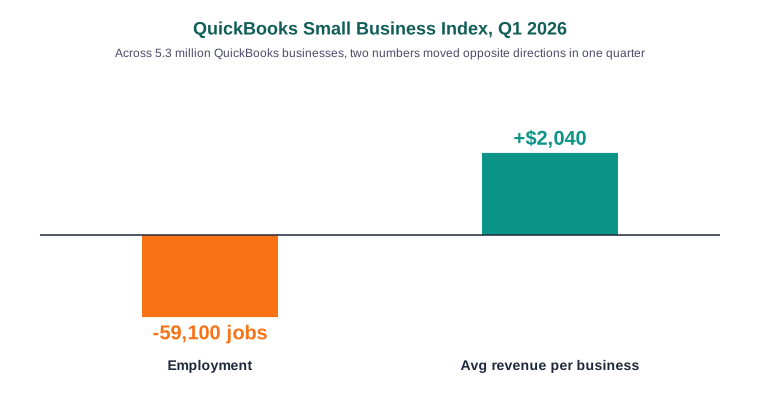
That's not a typo. According to the QuickBooks Small Business Index for Q1 2026, small businesses shed 59,100 jobs in the quarter while average revenue per business rose $2,040. Fewer people on payroll. More money coming in the door.
For decades, the growth formula in the trades was simple. Want more revenue? Add a truck and a tech. That math is breaking, and the businesses figuring out the new version are pulling away from the ones still running the old one.
What the index is actually measuring
The QuickBooks Small Business Index isn't a survey. It's not a sample of owners guessing at how they feel about the economy. Intuit builds it from real, anonymized activity inside millions of QuickBooks businesses. It's what the books actually did, aggregated up.
So when the Q1 2026 reading shows employment dropping by 59,100 jobs and average revenue climbing by $2,040 in the same window, that's a measured fact about how small businesses operated this year. The average business produced more output with fewer hands on deck.
Output per worker went up. That single sentence is the whole story, and it has consequences for how you run a home services shop.
The hiring lever stopped working the way it used to
Here's the old model most contractors grew up with. Revenue is a function of bodies. Three trucks do three trucks' worth of work. Hire a fourth tech, run a fourth truck, book a fourth truck's worth of jobs. Growth equals headcount.
The Q1 2026 numbers describe a market where that relationship loosened. Businesses grew revenue while their total employment fell. They didn't add their way to a bigger top line. They got more out of the people they already had.
If you've tried to hire a licensed tech in the last two years, you already know why this is happening. Good people are hard to find, expensive to keep, and slow to ramp. Throwing bodies at growth was never cheap, and right now it's harder than it's been in a long time. The businesses that figured out how to grow revenue per person sidestepped the whole problem.
The habit the winners have in common
So what separates a shop that squeezes more revenue out of the same crew from one that just runs everyone ragged? The data points at one thing over and over: the businesses pulling ahead pay attention to their numbers, and a growing share of them use software to do it.
Intuit's 2026 AI Impact Report is the biggest look at this we have. It surveyed more than 34,000 small and midsize businesses and analyzed 5.3 million QuickBooks businesses across the US, Canada, the UK, and Australia. A few findings stand out.
77% of US small and midsize businesses now use AI regularly. Two years ago, in July 2024, that figure was 48%. That's a massive shift in a short window, and it's not coming from giant corporations. It's small businesses, the ones with a dozen employees or fewer.
74% of them report improved productivity from those tools. That tracks with the index: more output per person.
The revenue signal is the one worth sitting with. Among AI-using businesses, 43% said it helped revenue go up, while only about 2% said it contributed to a decline. That's roughly a 20-to-1 split between businesses seeing gains and businesses seeing losses.
Now, I'd push back on anyone who reads that and concludes the software is magic. It isn't. A tool that books appointments or drafts an estimate doesn't create demand out of thin air. What it does is remove the friction and the blind spots that cap how much one person can handle. The owners reporting gains aren't winning because they bought a subscription. They're winning because they finally have visibility into what's working and what's leaking, and they act on it. The software is the lever. Knowing your numbers is the hand on the lever.
The trades are the holdout
Here's where home services contractors should pay attention, because the trades are not part of the 77%.
Roughly 65% of construction firms have not adopted AI in any form. While small businesses broadly are adopting these tools faster than ever, the trades are sitting it out at a higher rate than almost any other sector.
You can read that two ways depending on which side of it you're on.
If you're in the 65%, it's a warning. The contractor across town who books faster, prices tighter, and actually knows his margins by Friday is competing for the same jobs you are, with a structural cost advantage you can't see on a bid sheet. That gap compounds. A few points of margin reinvested every quarter is the difference between a shop that buys its competitor in five years and one that gets bought.
If you're willing to be an early mover, it's an opening. Most of your local competition is still doing everything by gut and memory. You don't need a moonshot. You need to close the visibility gap before they do.
What "more revenue per person" looks like on a real job
Abstract productivity stats don't pay your insurance bill, so let me make this concrete for a home services shop.
More revenue per person rarely comes from your crew suddenly working faster. Nobody installs a water heater 20% quicker because morale improved. It comes from a handful of unglamorous places that only show up when you're tracking them:
- Average ticket creeping up instead of down. A plumber whose average service ticket holds at $485 instead of sliding to $420 is generating real money per call with the exact same labor. That slide is invisible week to week and obvious across six months of data.
- The $150 maintenance visit that sells the $12,000 replacement. Maintenance customers convert to big-ticket replacement work at several times the rate of cold leads. A shop that tracks which maintenance visits are due is harvesting revenue a shop running blind never sees.
- Catching the low-margin drift early. Saying yes to more jobs feels like growth. If those jobs are lower-margin service calls, you're busier and not richer. Output per person is rising in hours and falling in dollars, and only the data tells you which one is happening.
- Collecting before the slow season instead of during it. Cash that's stuck in receivables can't fund a fourth truck or a price-tested marketing push. Knowing your aging by customer turns a vague "people pay slow" into a specific list you can actually work.
None of those require a single new hire. They require somebody reading the books closely enough to catch the pattern while it's still small. That's the productivity story hiding inside the index numbers.
Visibility is the lever you actually control
You can't improve output per person if you can't see output per person. That's the catch in the whole 2026 story. The businesses growing revenue with flat or shrinking headcount are, almost by definition, businesses that measure.
Most contractors don't. They open QuickBooks to send an invoice or check the balance, then close it. The data sits there, accurate and complete, telling nobody anything. We wrote a whole piece on the signals buried in your own file in What Your QuickBooks Data Is Trying to Tell You, and the short version is that the patterns are already in there. The problem is that nobody's reading them.
This is also where the gap between a bookkeeper and a business advisor shows up. A clean set of books tells you what happened. It does not tell you that your average ticket is sliding, that one customer is now 28% of your revenue, or that your margins are compressing while material costs sit flat. Categorizing transactions and interpreting them are different jobs, which is the argument we make in Why Your Bookkeeper Isn't Enough.
The fix doesn't have to be complicated. It's a habit before it's a tool. Pick five numbers, look at them on the same day every week, and act on what moved. That routine is the entire premise of The Monday Morning Financial Check, and it's the cheapest competitive advantage available to a small shop right now.
The takeaway for 2026
Strip away the headlines and the Q1 2026 data says something plain. The economy stopped rewarding businesses for being bigger and started rewarding them for being sharper. Employment fell, revenue per business rose, and the dividing line between the winners and everyone else runs straight through who knows their numbers and who doesn't.
The trades are the last big sector standing on the wrong side of that line. That won't last. The contractors who close the visibility gap now, while two-thirds of their competition is still flying blind, are the ones who'll show up in next year's index as the businesses doing more with less.
You already have the data. The question is whether anyone's reading it.
Streett Reports connects to your QuickBooks and turns the numbers into a plain-English insight report in your inbox every week. No dashboards to build, no spreadsheets to maintain, just the signals that tell you where your revenue per person is going.
Your first report is free, no credit card required.
Or see what it looks like: Plumbing | HVAC | Electrical
See what this looks like for YOUR business
Connect your QuickBooks in about 2 minutes. Your first report is free.
Get Your Free Report →