Are You a 5% Contractor or a 20% Contractor?
Two contractors, same trade and market, one nets 5% and one nets 20%. The difference isn't skill. It's knowing your real net margin. Here's the gap.
On this page
- Two Trucks, Same Street, Different Lives
- Most Contractors Can't Tell You Their Net Margin
- What "Good" Net Looks Like for Your Trade
- The $150,000 You're Leaving on the Table
- The 20% Contractor Isn't Smarter. He's Watching.
- The Traps That Keep You at 5%
- What Weekly Visibility Actually Catches
- Which Contractor Do You Want to Be
Two Trucks, Same Street, Different Lives
Two plumbing companies sit on the same side of town. Same trade, same customers, same going rate for a water heater swap. Both owners work hard. Both have good crews. Both stay busy.
One nets 5%. The other nets 20%.
At the end of the year, the first owner pulls a little money out and wonders why it feels so tight after all those calls. The second owner takes home four times as much on roughly the same revenue, funds a maintenance plan launch, and still has cash in the bank in February.
Nothing about their skill explains that gap. They install the same fixtures to the same code. The difference is that one of them knows his real net margin to the point, watches it move week to week, and runs the business around it. The other one knows he's "doing fine" because the phone keeps ringing.
This post is about the number that separates those two trucks, and the discipline behind the higher one.
Most Contractors Can't Tell You Their Net Margin
Ask a room full of contractors what their gross margin is and a few hands go up. Ask what their net margin was last month and the room goes quiet.
That silence is the whole problem. You can't manage a number you never look at. And net margin is the number that decides whether you own a business or just own a very demanding job.
Net margin is what's left after everything. Not just labor and materials. After the truck payments, the insurance, the office software, the yard rent, the phone answering service, the fuel, the owner's pay, and the thousand small line items that never show up when you're staring at a single invoice. Gross margin tells you whether your jobs are priced right. Net margin tells you whether your company actually makes money.
A lot of owners confuse the two and assume a healthy gross margin means a healthy business. It doesn't. You can run a 60% gross margin and still net 4% if your overhead is bloated and nobody's watching it. This is different from the pricing question we covered in How to Know If You're Charging Enough. Pricing sets your gross. What you do with everything below the gross line is what sets your net.
What "Good" Net Looks Like for Your Trade
Generic advice says shoot for 10%. That number is useless on its own, because a healthy net depends on your trade and cost structure. A plumber and a general contractor should never be measured against the same line.
Here's what healthy net margin looks like by trade, and what the struggling end looks like:
| Trade | Healthy Net | Struggling Net |
|---|---|---|
| Plumbing | 20-35% | 2-8% |
| HVAC | 12-20% | 5-8% |
| Electrical | 15-20% | 5-10% |
| General Contracting | 8-15% | 2-5% |
| Roofing | 10-20% | 3-8% |
Plumbing carries the highest net ceiling because the work is labor-skill heavy and materials are a smaller slice of each ticket. HVAC and electrical land in the mid-teens, dragged down by equipment-heavy installs. General contracting runs leaner because subcontractor and material costs eat a big chunk before you ever touch overhead. Roofing swings wide because it lives and dies on weather and material prices.
Across all of them, the industry pattern holds. Most home service companies net somewhere between 5% and 12%. Well-run operations hit 15-20%. The owners in that top band aren't charging double. They're running tighter and they know their number.
The $150,000 You're Leaving on the Table
Let's put real money on this. Take a $1.5 million plumbing company, which is a normal size for an established shop with a few trucks.
At 8% net, the owner takes home $120,000. At 18% net, the owner takes home $270,000. Same revenue. Same trucks rolling. Same customers.
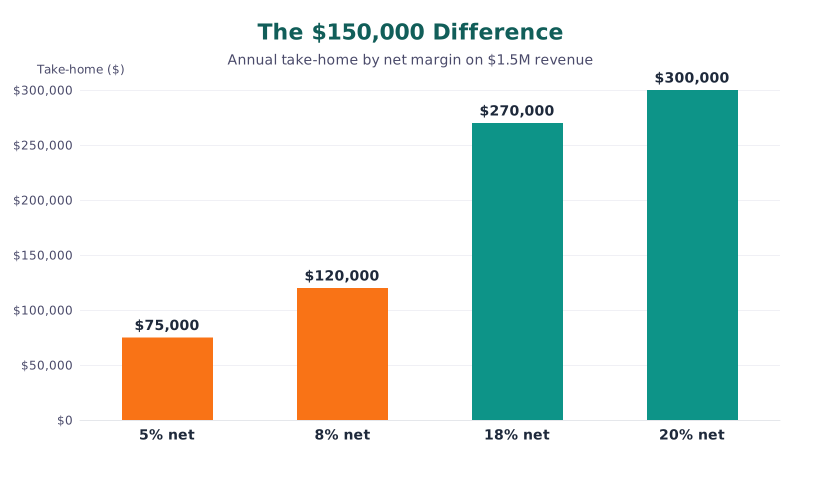
That's a $150,000 swing every single year, and it compounds. Ten points of net margin over five years is three quarters of a million dollars in take-home, retirement contributions, or money to reinvest in the business. It's the difference between buying a fourth truck in cash and financing it at today's rates.
Now look at the bottom end of the chart. A 5% contractor on that same $1.5M takes home $75,000 before he's paid himself a real salary. He's working 60-hour weeks to run a company that pays less than a lead tech makes. He doesn't see it that way, because the deposits keep landing and the business "feels" healthy. Revenue masks a lot of sins.
The 20% Contractor Isn't Smarter. He's Watching.
The contractors who hit the top band share a few habits, and none of them require an MBA.
They know their net margin in near real time. Not at tax time. Not when the bookkeeper finishes the quarter. Now. They can tell you this month is tracking at 16% and last month was 14% and they know why. That awareness alone changes behavior, because you can't course-correct against a number you see once a year.
They pay themselves a real wage first, then measure what's left. This is the single most common reason a "profitable" contractor is actually a 5% contractor in disguise. More on that trap below.
They watch overhead like it's a leak. Overhead should run 20-30% of revenue. The 5% contractor lets it drift to 38% over three years because each new subscription, lease, and hire felt small in the moment. The 20% contractor reviews it monthly and cuts what isn't earning.
They cost their jobs. They know which job types and which crews make money and which ones bleed. They stop selling the work that loses money even when it keeps everyone busy.
This is the same discipline a good outside set of eyes brings, which is exactly why a bookkeeper alone isn't enough. A bookkeeper records what happened. Hitting 20% requires someone or something reading the numbers forward and flagging the drift before it sets in.
The Traps That Keep You at 5%
If your net is stuck in single digits, the cause is almost always one of these four. None of them are about charging more.
1. You're Not Counting Your Own Pay
This is the big one. A huge number of contractors run their books with the owner's compensation buried, irregular, or missing entirely. So the P&L shows a 12% "profit" that includes the money you live on. Subtract a fair market salary for the work you actually do, dispatching, selling, managing, sometimes still turning wrenches, and the real net might be 3%.
Pay yourself a real wage as a line item. Whatever's left after that is your true net margin. If that number is thin, you've found your problem, and it was hiding in plain sight.
2. Overhead Crept Up and Nobody Noticed
Overhead creep is death by a thousand small yeses. A new software seat here, a bigger yard there, a part-time office hire, a truck wrap, a lead-gen subscription. Each one looked reasonable. Together they pushed your overhead from 24% to 36% of revenue while your prices stayed flat.
Pull your overhead as a percentage of revenue and compare it to the 20-30% target. If you're over, the fix isn't more sales. It's cutting the dead weight you stopped noticing.
3. You Don't Know Which Jobs Make Money
Plenty of contractors run a healthy blended gross margin and still bleed, because the average hides the losers. The new-construction work you took to keep the crew busy might run at 22% gross while your service calls run at 65%. Without job costing, you can't see it. You just feel busy and broke at the same time.
4. You're Confusing Profit With Cash
A profitable month and a flush bank account are not the same thing, and the gap can trick you into thinking your margins are fine when they aren't. You can post a great net on paper while your cash is stuck in 45-day receivables and material bills that hit the day you buy. The 5% contractor manages off his checking balance. The 20% contractor manages off his numbers and knows the difference between the two.
What Weekly Visibility Actually Catches
The reason most contractors stay at 5% isn't laziness. It's that the signals build slowly under the surface, and a once-a-year tax review is far too late to act on them. By the time you see the damage, you've already lived a full year inside it.
Here's the kind of thing that surfaces when someone reads your numbers every week instead of every April:
"Your net margin dropped from 15% to 11% over the past two months. Revenue held steady. Overhead rose from 27% to 33% of revenue. The leak is below the gross line, not in your pricing."
That's a four-point net swing caught in eight weeks instead of at year-end. On a $1.5M business, four points is $60,000.
"Your service work runs a 62% gross margin. The install jobs you added this quarter run 28%. The mix shift pulled your blended margin down even though every job was priced normally."
Without job-level visibility, that just looks like a soft quarter. With it, you can decide whether the install work is worth keeping or whether it's costing you money to stay busy.
"Owner's pay isn't booked as a consistent expense. Backing out a market salary for your role, real net margin is closer to 6% than the 13% the P&L shows."
That single correction is the one that wakes most owners up. The business they thought was healthy was paying them like a job, not an asset.
This is the same forward-looking read that separates the trades on more than just net. If you want to see how the cost structures and seasonal swings differ across HVAC, plumbing, and electrical, we broke that down here.
Which Contractor Do You Want to Be
The 5% contractor and the 20% contractor are often the same person at different stages. The gap closes the moment you stop guessing at your net and start watching it.
Start with the honest number. Book a real salary for yourself, pull your overhead as a percentage of revenue, compare your net to the benchmark for your trade, and look at it monthly instead of annually. None of that requires raising a single price. It requires looking.
Your QuickBooks already holds every number you'd need to know whether you're a 5% shop or a 20% shop. The only question is whether anyone's reading it before the year is already gone.
Streett Reports reads your QuickBooks data and emails you a plain-English report every week showing where your net margin is heading and exactly which part of your cost structure is moving it.
Your first report is free, no credit card required.
Or see what it looks like: Plumbing | HVAC | Electrical
See what this looks like for YOUR business
Connect your QuickBooks in about 2 minutes. Your first report is free.
Get Your Free Report →